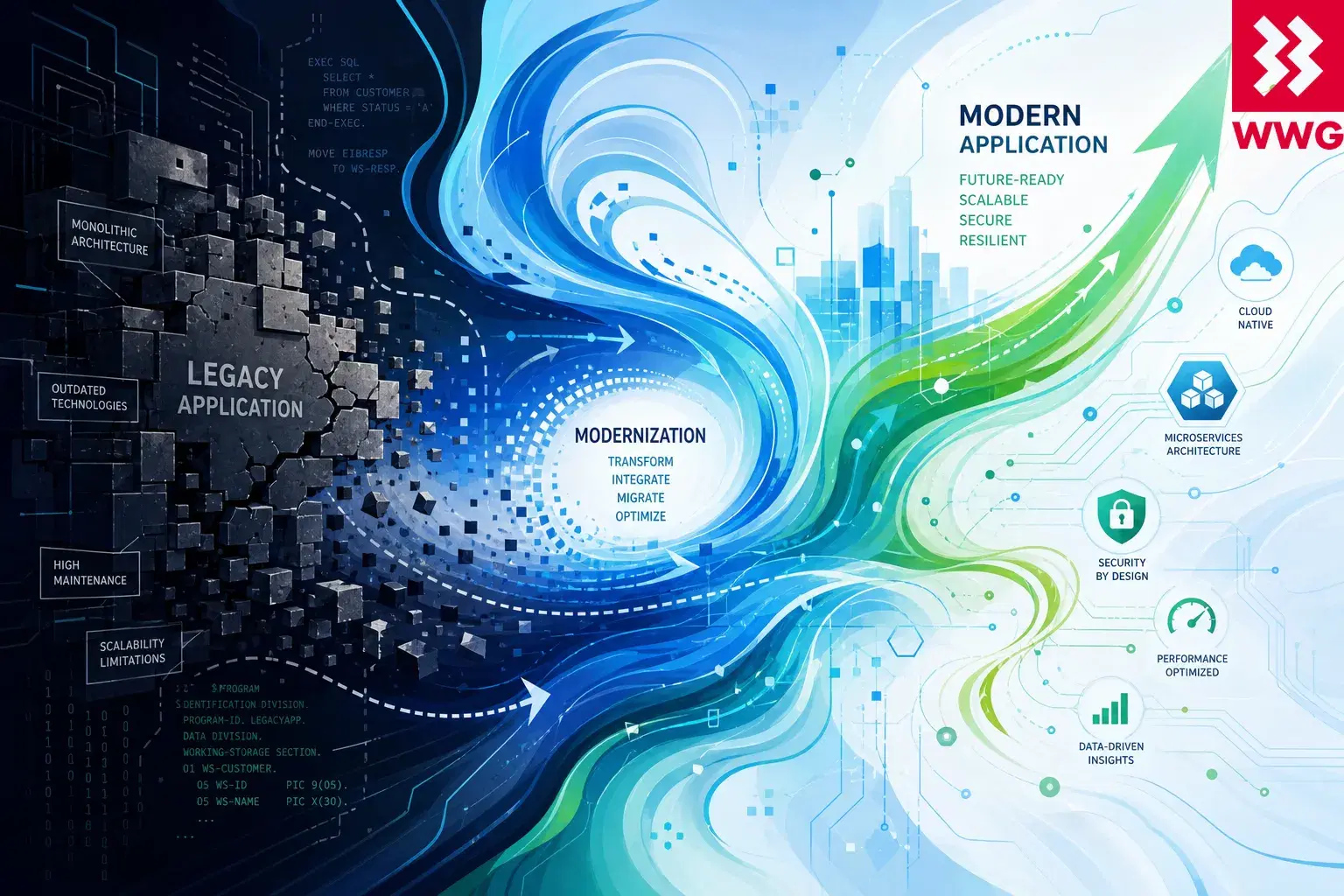
Legacy app modernization is the disciplined process of replacing, replatforming, refactoring, or rebuilding ageing business software so it becomes secure, maintainable, scalable, and easier to integrate. For European CTOs, the priority is not “new technology for its own sake”; it is reducing operational risk while enabling faster delivery, better data use, cloud adoption, and resilient growth.
TL;DR — Key Takeaways
- Legacy app modernization is a business-risk programme, not only an engineering project.
- Do not default to a big-bang rewrite; use portfolio assessment, the 7Rs, and phased replacement.
- Cloud migration helps only when paired with architecture and operating-model change.
- Modernisation must address data, security, compliance, and change management together.
- The best first step is an evidence-based application inventory, including dependencies, cost, risk, and business value.
What does legacy app modernization mean for growing European businesses?
Legacy app modernization means improving or replacing ageing applications so they can support current business, security, regulatory, integration, and scalability requirements. It is different from maintenance because it changes the system’s future cost and adaptability, rather than merely keeping it alive through patches, workarounds, and specialist support.
A legacy application is not simply “old”. It becomes legacy when it constrains change. That may mean it runs on unsupported technology, depends on scarce skills, blocks API integration, cannot meet security expectations, or makes every product change slow and risky.
The UK DSIT State of Digital Government Review — published 21 January 2025 and based on public-sector evidence, not a private-sector benchmark — defines legacy systems as those based on end-of-life products, out of supplier support, impossible to update, no longer cost-effective, or above an acceptable risk threshold. The same review found that some organisations such as DWP and NHS England spend up to 70–85% of technology budgets on upkeep rather than modernisation; this illustrates the mechanism of legacy drag, but should not be generalised uncritically to European SMEs. (gov.uk)
Modernisation matters now because European businesses are moving further into cloud, data, and AI-enabled operating models. According to Eurostat, published 3 February 2026 with a 2025 reference year, 52.7% of EU enterprises used paid cloud computing services in 2025, up 7.4 percentage points from 2023. Eurostat also reported, published 11 December 2025 with a 2025 reference year, that 20.0% of EU enterprises with 10 or more employees used AI technologies in 2025, up from 13.5% in 2024. (ec.europa.eu, ec.europa.eu)
Do not conflate these figures with every other “cloud adoption” metric. The European Commission’s 2026 State of the Digital Decade package, published 17 June 2026, reports a different monitoring indicator: 46.7% of EU enterprises use cloud computing, 39.9% use data analytics, and nearly 20% deploy AI. The difference matters because each metric has a different definition and policy context. (digital-strategy.ec.europa.eu)
A useful board-level visual is a simple “legacy pressure map”: business value on one axis, technical risk on the other, with systems grouped into retire, replace, replatform, and refactor candidates. For the wider portfolio view, including the regulatory changes and the cost of keeping legacy systems alive, see our guide to legacy system modernization best practices; this article focuses on replacing a specific application.
Modernising is not the same as maintaining
Maintenance keeps the current system running. Modernisation changes its economic and operational trajectory.
Maintenance usually means patching defects, renewing licences, adding small enhancements, and supporting users. Modernisation may include cloud migration, database replacement, API enablement, modularisation, user experience redesign, automated testing, DevOps adoption, or full legacy software replacement.
Typical indicators that it is time to modernise include:
- release cycles measured in months rather than days or weeks;
- unsupported frameworks, operating systems, databases, or middleware;
- manual regression testing that slows every change;
- business rules hidden in code that few people understand;
- point-to-point integrations that break when one system changes;
- poor observability, weak auditability, or fragile recovery processes;
- rising cost without corresponding business capability;
- inability to support mobile, self-service, partner APIs, analytics, or AI use cases.
For CTOs at 50–500 employee businesses, the decision should not start with “Which cloud?” or “Which framework?” It should start with the application’s business role. A legacy system that runs a declining internal workflow needs a different answer from one that supports revenue, regulatory reporting, logistics, or customer experience.
Which strategies work best for replacing legacy software?
The best strategy depends on business value, technical risk, regulatory exposure, dependency complexity, and the required speed of change. Most organisations need a portfolio of approaches: retire low-value systems, repurchase commodity tools, replatform stable workloads, and refactor or rebuild differentiating capabilities in controlled increments.
AWS Prescriptive Guidance describes seven common migration strategies — retire, retain, rehost, relocate, repurchase, replatform, and refactor or re-architect — and notes that refactoring during large migrations is complex; many programmes first migrate or replatform, then modernise. This is a useful structure even outside AWS because it separates business intent from implementation detail. (docs.aws.amazon.com)
| Strategy | When to use it | Main risk |
|---|---|---|
| Retire | The application has no active business owner or low usage | Hidden dependencies |
| Retain | Migration brings no immediate benefit or the system has special constraints | Risk remains unmanaged |
| Rehost | The workload is stable and needs infrastructure exit quickly | Cloud cost without modernisation |
| Replatform | Managed services can reduce operational burden | Partial change may expose old design flaws |
| Repurchase | SaaS meets the business need better than custom code | Process change and data migration |
| Refactor | The capability differentiates the business and must evolve | Scope creep and delivery risk |
| Rebuild | The current system cannot support future requirements | Overrun if treated as a “clean-sheet” rewrite |
A practical step-by-step replacement plan
Start with discovery. Build an application inventory that records ownership, users, business processes, integrations, data stores, infrastructure, licences, incident history, release frequency, compliance requirements, and known vulnerabilities.
Then score each system against four dimensions:
- Business criticality — revenue, customer impact, operational dependency.
- Technical health — code quality, test coverage, support status, maintainability.
- Change demand — backlog pressure, market change, regulatory change.
- Replacement feasibility — data complexity, vendor options, integration risk.
Next, create a wave plan. Do not modernise the most fragile mission-critical application first unless external pressure forces it. A safer approach is to prove the delivery model on a medium-risk system, then move to higher-value workloads once patterns, tooling, and governance are working.
Cloud migration can be powerful, but only when it changes the operating model. Moving virtual machines into the cloud without improving deployment, observability, security, cost management, or integration often preserves the old problems in a new hosting environment.
Microservices can help where teams need independent deployability, bounded business capabilities, and elastic scaling. But microservices are not a universal cure. Many mid-sized companies are better served by a modular monolith, clear APIs, automated tests, and a managed database before they introduce distributed-system complexity. If you are still deciding between rewriting and improving the existing code, our rewrite vs refactor decision framework walks through the trade-offs.
The strangler fig pattern
The strangler fig pattern is often the safer route for critical systems. Martin Fowler describes the term as a gradual approach to legacy modernisation, where new capability grows around and progressively replaces the old system. (martinfowler.com)
The architecture usually places an API, proxy, or integration layer in front of the legacy application. New services then take over one capability at a time while the old system continues to run.
A strong legacy app modernization plan should also define exit criteria. Examples include “all customer onboarding traffic runs through the new service”, “the old reporting database is read-only”, or “the vendor licence can be cancelled after quarter-end close”. Without exit criteria, modernisation becomes permanent coexistence.
How can CTOs overcome the challenges of modernization?
CTOs overcome modernization challenges by treating them as product, architecture, data, security, and change-management risks — not isolated technical tasks. The strongest programmes combine dependency mapping, staged delivery, automated testing, security controls, collaborative governance, and clear accountability for business outcomes, not just system cutover.
The first challenge is incomplete knowledge. Legacy systems often contain undocumented business rules, batch jobs, reports, database triggers, file transfers, and manual workarounds. Before replacement, run structured discovery workshops with business users, support teams, security, finance, operations, and developers who understand the “edge cases”.
The second challenge is data. Data migration is rarely a simple export-import exercise. You may need to clean duplicate records, map old fields to new domain models, preserve audit trails, define retention rules, and reconcile data after cutover. For regulated sectors, this must align with GDPR Article 32 security-of-processing obligations, which require appropriate technical and organisational measures based on risk. (eur-lex.europa.eu)
The third challenge is compliance. NIS2 required Member States to transpose the directive by 17 October 2024; Article 20 requires management bodies of essential and important entities to approve and oversee cybersecurity risk-management measures, while Article 21 covers the substance of those measures. Corporate obligations depend on national implementation, but the governance direction is clear: cyber resilience is increasingly a management issue, not only an IT control. (digital-strategy.ec.europa.eu)
In financial services, DORA became binding on 17 January 2025 for financial entities across the EU, after entering into force on 16 January 2023. ENISA states that DORA strengthens digital operational resilience and oversight of critical third-party ICT providers, which makes legacy dependencies and supplier concentration directly relevant to architecture decisions. (enisa.europa.eu)
The EU Data Act also started applying on 12 September 2025, including provisions intended to help cloud users switch providers or use several providers in parallel. For modernisation programmes, that strengthens the case for portability, exit planning, and avoiding unnecessary lock-in in data and integration layers. (digital-strategy.ec.europa.eu)
A practical risk-control model has four layers: business continuity, data integrity, security, and adoption. Each layer needs owners, tests, and rollback options.
Change management is part of the architecture
Effective collaboration determines whether the new system is used properly. If finance, operations, sales, or compliance teams feel the programme is being “done to them”, they will protect old workflows, spreadsheets, and shadow systems.
Use a product-led governance model. Give each modernisation stream a business owner, technical owner, delivery lead, and security representative. Review decisions through a lightweight architecture board that can unblock trade-offs quickly.
For teams, modern IT solutions should include CI/CD, automated regression testing, infrastructure as code, secrets management, application performance monitoring, centralised logging, and incident runbooks. These capabilities reduce the risk of changing old systems because every release becomes more observable and repeatable.
Finally, control scope. The worst modernisation programmes combine replacement, redesign, process transformation, data clean-up, reporting overhaul, and new analytics in one overloaded release. Separate “must move now” from “should improve next”. Modernise the runway as well as the aircraft.
What benefits can businesses expect from modernizing legacy applications?
Modernizing legacy applications improves delivery speed, operational resilience, security, scalability, integration, user experience, and data readiness. The financial benefit comes from reducing avoidable upkeep, manual work, incident load, and opportunity cost — while enabling faster product change, better analytics, and more adaptable infrastructure.
The benefit case should be specific, not generic. “Lower cost” is weak unless you connect it to retiring servers, reducing licence exposure, automating manual support, consolidating platforms, improving test automation, or removing specialist legacy dependencies.
Accenture’s Reinventing with a Digital Core research, published 17 July 2024 and based on 1,500 C-suite IT executives across 19 industries and 10 countries, found that organisations combining an advanced digital core, strategic innovation investment, and a balanced approach to technical debt achieved up to 60% higher revenue growth rates and 40% higher profits. This is a conditional, capped finding from Accenture’s study — not a guaranteed uplift from any single modernisation project. (newsroom.accenture.com)
Modernisation also improves strategic optionality. Once core applications expose reliable APIs, run on supported platforms, and use cleaner data models, the business can introduce partner portals, self-service journeys, analytics products, automation, and AI assistants faster.
A simple benefit flywheel starts with better architecture, which enables faster delivery, which improves business feedback, which funds further simplification.
What successful modernisation looks like in practice
Vendor case studies should be read as examples, not universal benchmarks. Microsoft’s OYAK ANKER Bank customer story, published 21 September 2026, reports that the bank moved from ageing monolithic systems to Azure PaaS services including App Services, Function Apps, Logic Apps, API Management, and Azure SQL. Microsoft reports 100% uptime during migration, around 80% faster product launches, 55% automated workloads, and 50% faster incident resolution; those are the vendor-reported outcomes for that specific banking case. (microsoft.com)
For a 50–500 employee company, the same pattern is often smaller but just as material. A wholesale distributor might replace a fragile order-entry application with a cloud-native workflow and API layer. A manufacturer might replatform a production-planning system while preserving on-premise machine integrations. A professional-services firm might retire bespoke finance workflows and repurchase a SaaS platform.
The common thread is not the technology brand. It is the sequence: discover, prioritise, stabilise, modernise in slices, migrate data carefully, automate delivery, and decommission what is no longer needed.
Track outcomes through a balanced scorecard:
- Delivery: deployment frequency, lead time for change, escaped defects.
- Reliability: incident frequency, recovery time, availability, error budgets.
- Cost: licence reduction, infrastructure run-rate, support hours.
- Security: critical vulnerabilities, patch latency, access-control findings.
- Business: onboarding time, order cycle time, customer self-service, employee productivity.
The strongest business case combines hard savings with growth enablement. Modernisation should release capacity from low-value upkeep and redirect it into digital products, integration, automation, and data-driven decision-making.
For European digital leaders, legacy app modernization is ultimately about control. It gives you control over risk, roadmap, cost, data, and the pace of change. That is why replacing software that still “works” can be one of the most commercially important technology decisions you make.
If the system is fragile today, stabilise it before you replace it: WWG's software stabilization work fixes the incidents, releases and monitoring first, so the replacement does not start in crisis mode. If you first need an evidence base for the decision, a software audit maps the code, architecture, dependencies and risks of the application you are thinking of replacing.
Talk to our engineering team →
Sources
The sources below were used to verify statistics, regulatory dates, case-study claims, and recognised modernisation frameworks cited in this article. Where figures are vendor-reported or based on a specific public-sector review, the article labels their scope and avoids treating them as universal benchmarks.
- Eurostat — “53% EU enterprises used paid cloud services in 2025”, published 3 February 2026. URL: (ec.europa.eu)
- Eurostat — “20% of EU enterprises use AI technologies”, published 11 December 2025. URL: (ec.europa.eu)
- European Commission — “2026 State of the Digital Decade package”, published 17 June 2026. URL: (digital-strategy.ec.europa.eu)
- UK DSIT — State of Digital Government Review, published 21 January 2025. URL: (gov.uk)
- Accenture — “New Research from Accenture Finds that Digital Core Investments Accelerate Reinvention and Innovation”, published 17 July 2024. URL: (newsroom.accenture.com)
- AWS Prescriptive Guidance — “About the migration strategies”. URL: (docs.aws.amazon.com)
- Martin Fowler — “Strangler Fig Application”. URL: (martinfowler.com)
- European Commission — “NIS2 Directive: securing network and information systems”. URL: (digital-strategy.ec.europa.eu)
- EUR-Lex — NIS2 Directive, Directive (EU) 2022/2555, Articles 20 and 21. URL: (eur-lex.europa.eu)
- ENISA — “EU financial entities cybersecurity upgrade: DORA is now alive and kicking”, published 17 January 2025. URL: (enisa.europa.eu)
- European Commission — “EU Data Act gives users control over data from connected devices”, published 12 September 2025. URL: (digital-strategy.ec.europa.eu)
- EUR-Lex — GDPR Article 32, Regulation (EU) 2016/679. URL: (eur-lex.europa.eu)
- Microsoft Customer Stories — “OYAK ANKER Bank transforms operations on Microsoft Azure”, published 21 September 2026. URL: (microsoft.com)
FAQ
Frequently Asked Questions
Practical answers for technology leaders planning to replace or modernise legacy applications.