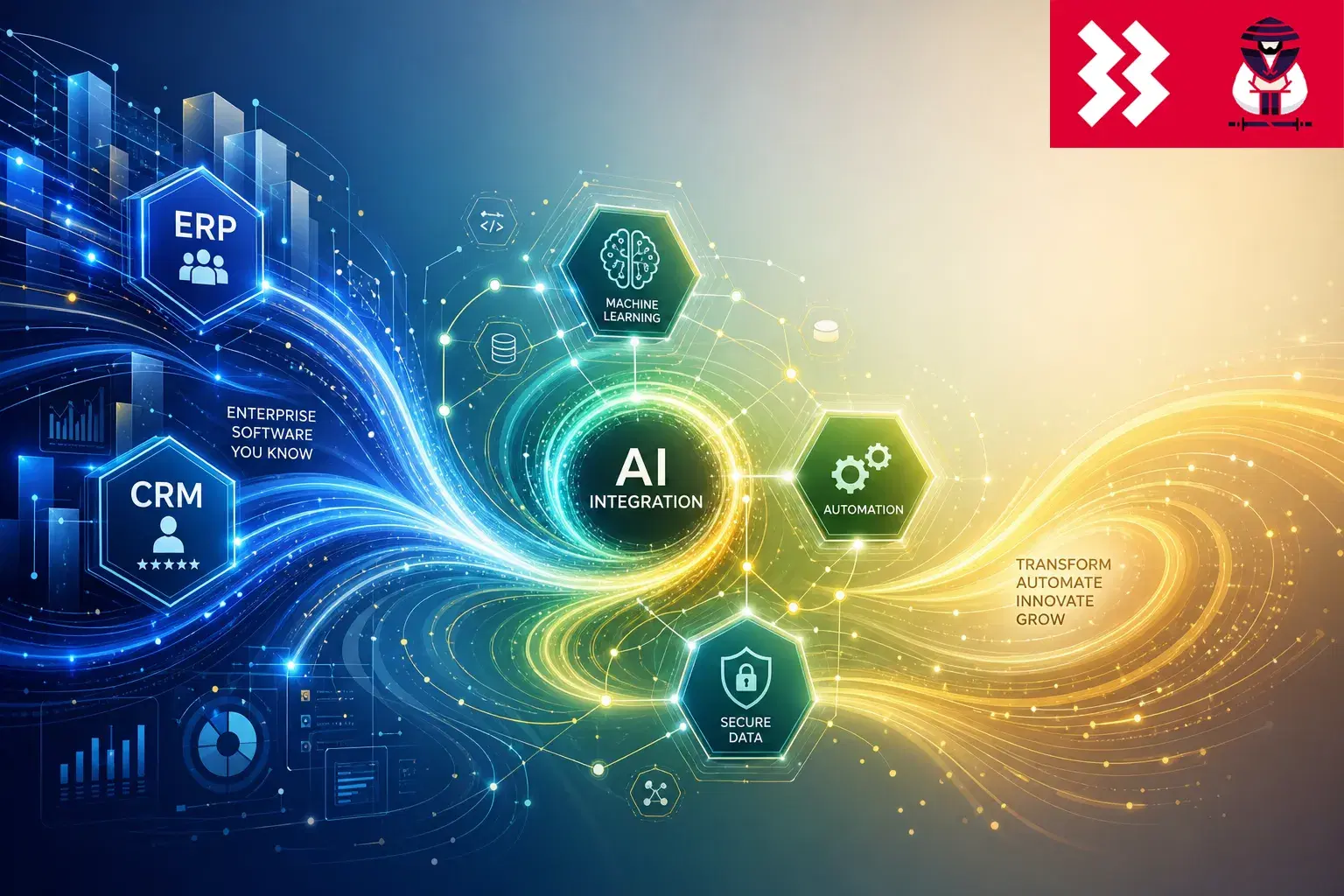
AI integration enterprise software means embedding machine learning, generative AI and automation capabilities into the systems that already run your business: ERP, CRM, BI, workflow tools, portals and bespoke platforms. For European CTOs, the priority is not experimentation for its own sake; it is controlled modernisation that improves workflows, protects data and remains compliant as regulation matures.
TL;DR: Key Takeaways
- Start with a business workflow, not a model choice.
- Use AI where existing enterprise software already holds useful context.
- Select the right pattern: API integration, RAG, copilot, automation or embedded decision support.
- Treat governance, AI literacy, monitoring and security as architecture requirements.
- Scale only after proving adoption, accuracy, cost and operational impact.
What does AI integration in enterprise software mean for European enterprises?
AI integration in enterprise software is the controlled embedding of AI capabilities into existing business platforms so users can predict, classify, generate, search, recommend or automate inside familiar workflows. The value comes from connecting AI to trusted enterprise data, permissions and processes, not from adding another standalone chatbot to the technology estate.
For mid-sized European enterprises, the timing is important. According to Eurostat (news item dated 11 December 2025; 2025 reference year), 20.0% of EU enterprises with 10 or more employees used AI technologies, up from 13.5% in 2024; the most common AI use was analysing written language at 11.8% of enterprises. (ec.europa.eu)
That matters because much enterprise value is text-heavy: support tickets, contracts, sales notes, compliance evidence, product specifications, procurement requests and internal knowledge articles. AI integration turns those documents and interactions into searchable, summarised and actionable workflow inputs.
At a systems level, AI integration normally touches five layers: the user interface, business logic, data access, model orchestration and governance. The strongest architectures make those layers explicit before implementation begins.
A practical AI architecture does not force every use case into the same pattern. An invoice-matching workflow may need deterministic rules plus anomaly detection. A service desk assistant may need retrieval-augmented generation (RAG) connected to approved knowledge. A product team may need Figma-to-code assistance, while finance may need explainable forecasting inside BI dashboards.
The existing enterprise software landscape is already diverse. According to Eurostat (published 20 May 2026; 2025 reference year), 53% of EU enterprises used specialised e-business software such as ERP, CRM or BI in 2025, with ERP usage ranging from 41% of small enterprises to 89% of large enterprises. (ec.europa.eu)
Cloud adoption also changes the integration model. According to Eurostat’s Digitalisation in Europe – 2026 edition (2025 reference year), 53% of EU businesses bought cloud computing services, while 85% of large businesses did so. (ec.europa.eu) For AI integration, this means many organisations can combine SaaS APIs, cloud data platforms and secure identity controls rather than build all infrastructure from scratch.
The strategic point is simple: AI should extend enterprise systems such as SAP, Microsoft Dynamics, Salesforce, ServiceNow, custom portals and data platforms. It should not create a parallel universe of ungoverned prompts, copied data and invisible decisions.
European regulation reinforces that principle. According to the European Commission (AI Act implementation page, accessed 24 September 2026), the EU AI Act entered into force on 1 August 2024, became broadly applicable on 2 August 2026, and AI literacy plus prohibited-practice rules applied from 2 February 2025. (digital-strategy.ec.europa.eu) According to the Commission’s AI literacy guidance (accessed 24 September 2026), AI Act Article 4 requires providers and deployers to support AI literacy for staff and other users operating AI systems on their behalf. (digital-strategy.ec.europa.eu)
How should you integrate AI into your existing systems?
Integrate AI into existing systems by choosing one priority workflow, mapping its data and decision points, selecting an integration pattern, building a secure pilot, measuring business and technical KPIs, and scaling through governed APIs, monitoring and change management. This step-by-step approach reduces delivery risk and avoids disconnected AI experiments.
Here is the featured-snippet version:
- Identify a workflow with measurable friction.
- Confirm data quality, ownership and lawful use.
- Choose the AI pattern: RAG, prediction, classification, generation or agentic automation.
- Build a thin integration layer using APIs and existing identity controls.
- Add guardrails, logging, human review and fallback paths.
- Pilot with real users and benchmark against the current process.
- Scale only when accuracy, adoption, cost and risk thresholds are met.
The most common mistake is starting with a vendor demo. Start instead with a workflow statement: “Reduce support triage time,” “accelerate product specification review,” “assist developers with legacy code comprehension,” or “improve sales proposal consistency.” That forces the team to define success in operational language.
Then select the right integration pattern.
| Integration pattern | When to use it | Risk profile |
|---|---|---|
| Embedded copilot | Users need assistance inside CRM, ERP or a portal | Medium: requires UX and permission design |
| RAG knowledge assistant | Answers must come from approved internal content | Medium: depends on content quality and retrieval accuracy |
| Predictive model | Forecasting, churn, demand or anomaly detection | Medium-high: requires model monitoring |
| Document automation | Contracts, invoices, tickets or compliance packs | Medium: needs validation and exception handling |
| Agentic workflow | Multi-step tasks across tools | High: requires strong permission boundaries |
Tools such as Figma and Claude are useful when they shorten the path from design to implementation or from user request to controlled system action. According to Figma (blog post published 4 June 2025), its Dev Mode MCP server brings Figma context into developer workflows so large language models can generate more design-informed code in tools such as Copilot, Cursor, Windsurf and Claude Code. (figma.com)
Claude is relevant at the orchestration layer. According to Anthropic’s Claude Platform Docs (accessed 24 September 2026), tool use, also called function calling, lets Claude call developer-defined or Anthropic-provided functions, returning structured tool calls for the application to execute. (platform.claude.com) In enterprise terms, that means the model should not “do everything”; it should request approved operations through controlled functions.
A robust AI integration architecture usually includes:
- Identity and access control: connect to existing IAM and role-based permissions.
- Data gateway: retrieve only approved records, documents and metadata.
- Model orchestration: route tasks to the right model, prompt and tool.
- Policy layer: enforce logging, redaction, human approval and audit trails.
- Evaluation harness: test accuracy, safety, latency, cost and regression.
- Observability: monitor prompts, retrieval quality, tool calls and user outcomes.
This is where a software house such as WWG can add practical value: integration is not simply “calling an AI API”. It is software engineering across business processes, cloud architecture, data protection, UX, DevOps, QA and governance.
The build-versus-buy decision should be pragmatic. Use standard SaaS AI features where they meet security, data residency and workflow needs. Build custom AI layers where differentiation, legacy integration, domain language or compliance requires tighter control. For many European mid-sized companies, the best answer is hybrid: buy commodity capabilities, build the integration layer and retain ownership of core workflows.
How can AI enhance enterprise workflows without creating another tool silo?
AI enhances enterprise workflows when it removes friction from existing processes: summarising context, drafting content, classifying work, recommending next actions, detecting anomalies and automating repetitive hand-offs. It creates a tool silo when users must copy data into separate AI interfaces without governance, traceability or connection to business systems.
The workflow lens is essential. AI should improve the path from trigger to outcome: customer request to resolution, lead to quote, design to release, incident to remediation, order to cash, or requirement to deployed code. If AI sits outside that path, adoption will depend on individual enthusiasm rather than operational necessity.
Content AI is often the fastest route to value because enterprise work is full of language. It can summarise meetings into CRM updates, classify support tickets, draft knowledge articles, compare contract clauses, generate test cases from requirements or convert product documentation into sales enablement material. The control point is source grounding: users need to know which documents, fields and policies informed the output.
Evidence supports the workflow-first view, but leaders must read the numbers carefully. According to NBER Working Paper 31161, Generative AI at Work (2023), a study of 5,179 customer support agents found that access to a generative AI conversational assistant increased productivity by 14% on average, with larger gains for novice and lower-skilled workers. (nber.org) This is a workflow-specific result, not a universal productivity guarantee.
Software delivery shows a similar pattern. According to Peng, Kalliamvakou, Cihon and Demirer (arXiv paper dated 13 February 2023; experiment conducted May–June 2022), developers with access to GitHub Copilot completed a JavaScript HTTP server task 55.8% faster than the control group. (arxiv.org) The study measured a controlled programming task, not every form of enterprise engineering.
| Workflow | Practical AI enhancement | What to measure |
|---|---|---|
| Customer support | Ticket summary, answer suggestion, routing | Resolution time, escalation rate, CSAT |
| Software delivery | Code explanation, test generation, design-to-code | Lead time, review defects, developer adoption |
| Sales operations | Proposal draft, account research, CRM updates | Quote cycle time, win-rate influence |
| Finance operations | Invoice matching, anomaly detection | Exception rate, manual handling time |
| Compliance | Evidence gathering, policy comparison | Review time, audit completeness |
Current enterprise surveys also show the gap between individual productivity and enterprise-level financial impact. According to McKinsey’s The state of AI in 2026: On the road to ROI (published 25 August 2026; online survey fielded 4 May–8 June 2026; 1,719 respondents in 97 nations), 80% of respondents said AI improved their individual productivity, while 37% reported AI had contributed positively to EBIT. (mckinsey.com)
That gap is the integration challenge. Personal productivity appears quickly; enterprise productivity arrives when processes, incentives, data access, quality controls and operating models change. The immediate work is more concrete: redesign workflows around verifiable AI assistance.
How do you overcome the main challenges in AI integration?
The main AI integration challenges are data quality, legacy complexity, security, cost control, regulatory compliance, hallucinated outputs, unclear ownership and weak adoption. Overcome them with governed architecture, model evaluation, human-in-the-loop controls, role-based access, AI literacy, observability and phased rollout tied to business KPIs rather than novelty.
Start with data. AI systems amplify the quality of the data, documents and metadata they receive. If product data is duplicated, customer records conflict, permissions are inconsistent or policies are outdated, AI will produce confident but unreliable outputs. Data readiness work may feel unglamorous, but it is the foundation of reliable enterprise AI.
Security must be designed in from day one. According to OWASP’s 2025 Top 10 Risk & Mitigations for LLMs and Gen AI Apps (2025 list, accessed 24 September 2026), prompt injection, sensitive information disclosure and supply-chain weaknesses are among the listed LLM application risks. (genai.owasp.org) For agentic AI, least privilege is not optional; it is the difference between useful automation and uncontrolled execution.
IBM’s breach research illustrates the stakes. According to IBM’s 2026 Cost of a Data Breach Report press release (published 29 July 2026; study of 602 organisations breached between March 2025 and February 2026), one in four malicious breaches were AI-enabled and the global average breach cost was USD 4.99 million; this is a vendor-sponsored security benchmark, so treat it as a risk signal rather than a universal enterprise cost forecast. (newsroom.ibm.com)
Regulatory obligations depend on role, sector, use case and jurisdiction. GDPR remains central where personal data is used. According to European Commission GDPR guidance (accessed 24 September 2026), organisations must inform individuals when processing personal data for automated decision-making and must use data protection by design and by default; GDPR Articles 35–36 cover Data Protection Impact Assessments. (commission.europa.eu)
Cybersecurity regulation also matters. According to ENISA (NIS2 page accessed 24 September 2026), Directive (EU) 2022/2555 entered into force on 16 January 2023 and Member States had to transpose NIS2 into national law by 17 October 2024. (enisa.europa.eu) Corporate obligations depend on national implementation, sector and entity classification, so CTOs should involve legal and security teams early.
Future-proofing requires governance that can evolve. According to ISO (ISO/IEC 42001:2023 page, publication date December 2023), ISO/IEC 42001 provides requirements for establishing, implementing, maintaining and continually improving an AI management system. (iso.org) According to NIST (AI RMF 1.0, created 26 January 2023), the AI Risk Management Framework provides a structured reference for trustworthy and responsible AI risk management. (nist.gov)
For implementation, use a simple operating model:
- AI product owner: accountable for business value and adoption.
- Technical owner: accountable for architecture, integration and reliability.
- Data owner: accountable for data quality and lawful use.
- Security owner: accountable for threat modelling and controls.
- Compliance owner: accountable for AI Act, GDPR, NIS2 and sector rules.
- User champions: accountable for feedback and workflow fit.
The best AI integration programmes stay intentionally boring in production: versioned prompts, test suites, fallbacks, approvals, monitoring, cost controls, audit logs and clear ownership. That discipline is what turns AI from a promising prototype into dependable enterprise software.
Discover how to integrate AI into your enterprise systems and transform your business operations today. Talk to us about where to start.
Sources
- Eurostat — “20% of EU enterprises use AI technologies”, 11 December 2025: https://ec.europa.eu/eurostat/de/web/products-eurostat-news/w/ddn-20251211-2
- Eurostat — “Larger enterprises used more e-business apps in 2025”, 20 May 2026: https://ec.europa.eu/eurostat/en/web/products-eurostat-news/w/ddn-20260520-1
- Eurostat — Digitalisation in Europe – 2026 edition: https://ec.europa.eu/eurostat/web/interactive-publications/digitalisation-2026
- European Commission — AI Act implementation page: https://digital-strategy.ec.europa.eu/en/policies/regulatory-framework-ai
- European Commission — AI talent, skills and literacy: https://digital-strategy.ec.europa.eu/en/policies/ai-talent-skills-and-literacy
- Figma — “Introducing our MCP server: Bringing Figma into your workflow”, 4 June 2025: https://www.figma.com/blog/introducing-figma-mcp-server/
- Anthropic — Claude Platform Docs, tool use: https://platform.claude.com/docs/en/agents-and-tools/tool-use/overview
- NBER — Generative AI at Work, Working Paper 31161, 2023: https://www.nber.org/papers/w31161
- arXiv — The Impact of AI on Developer Productivity: Evidence from GitHub Copilot, 13 February 2023: https://arxiv.org/abs/2302.06590
- McKinsey — The state of AI in 2026: On the road to ROI, 25 August 2026: https://www.mckinsey.com/capabilities/quantumblack/our-insights/the-state-of-ai
- OWASP — 2025 Top 10 Risk & Mitigations for LLMs and Gen AI Apps: https://genai.owasp.org/llm-top-10/
- IBM — 2026 Cost of a Data Breach Report press release, 29 July 2026: https://newsroom.ibm.com/2026-07-29-ibm-study-one-in-four-malicious-breaches-are-ai-enabled,-costing-companies-6-million-on-average
- European Commission — GDPR obligations for organisations: https://commission.europa.eu/law/law-topic/data-protection/information-business-and-organisations/obligations_en
- ENISA — NIS Directive 2: https://www.enisa.europa.eu/topics/state-of-cybersecurity-in-the-eu/cybersecurity-policies/nis-directive-2
- ISO — ISO/IEC 42001:2023 AI management systems: https://www.iso.org/standard/42001
- NIST — Artificial Intelligence Risk Management Framework AI RMF 1.0: https://www.nist.gov/publications/artificial-intelligence-risk-management-framework-ai-rmf-10
FAQ
Frequently Asked Questions
Practical answers for European technology leaders planning AI integration.