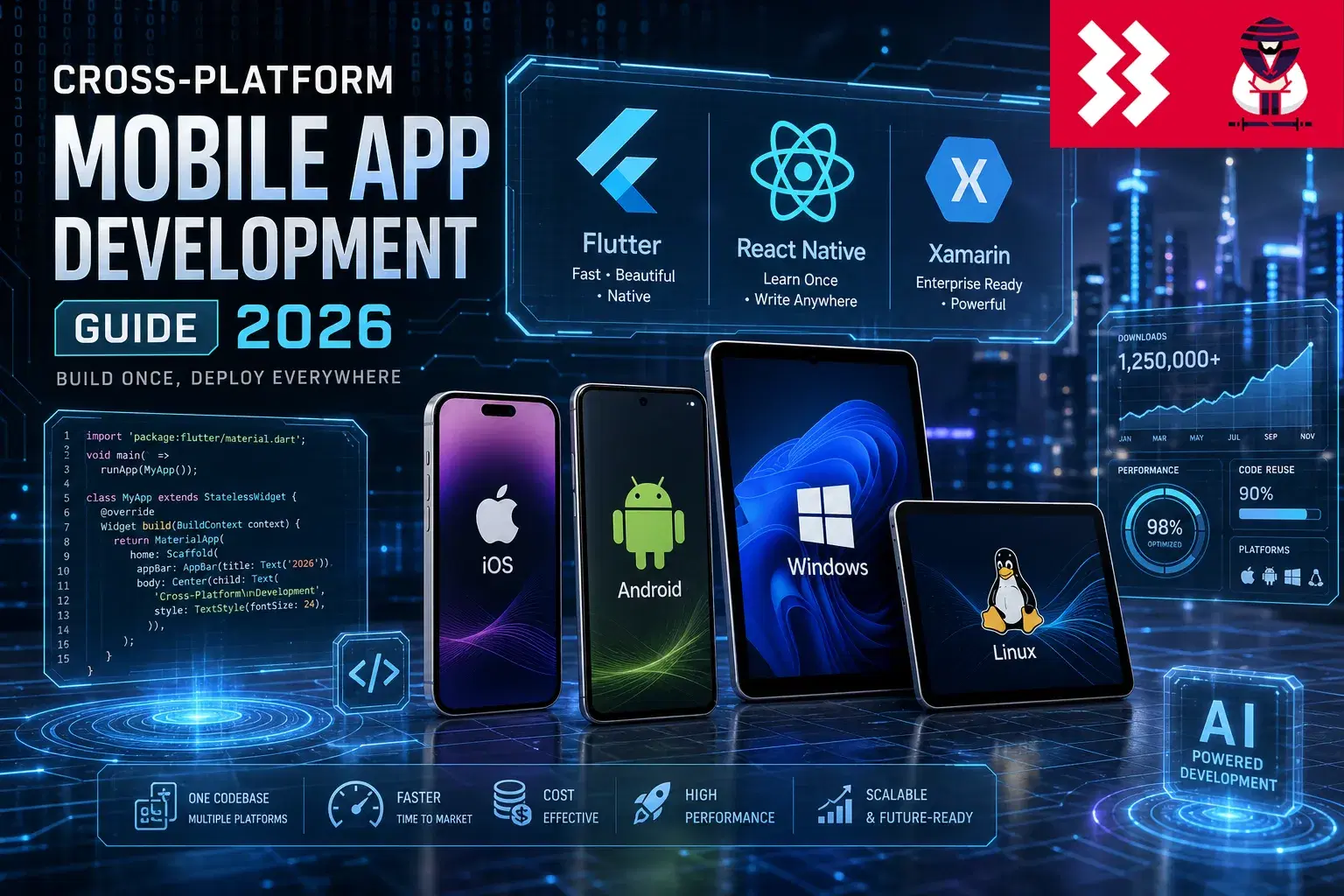
Cross-platform app development in 2026 is no longer a tactical shortcut for “one app on two platforms”; it is a strategic delivery model for building mobile products across iOS, Android, web, wearables and emerging AI-enabled devices. For European CTOs and VPs of Engineering, the decision is less about chasing the newest framework and more about selecting the architecture, governance and team model that can sustain product velocity without locking the business into fragile abstractions.
TL;DR / Key Takeaways
- Shortlist first, benchmark second: Flutter, React Native/Expo, Kotlin Multiplatform, .NET MAUI, Ionic/Capacitor and NativeScript each solve different enterprise constraints.
- Europe remains a two-platform market: StatCounter Global Stats shows Android at 62.73% and iOS at 37.25% of European mobile OS share in August 2026, accessed 17 September 2026. (gs.statcounter.com)
- Cross-platform works best with native escape routes: Plan early for Swift, Kotlin, Swift Package Manager, Android Gradle Plugin and platform SDK updates.
- AI changes the roadmap: On-device AI, agent-assisted development, XR and IoT integrations will reward teams with modular, testable shared logic.
- Do not generalise case-study numbers: BMW, Shopify, Forbes and Philips illustrate mechanisms, not universal benchmarks.
What is cross-platform app development in 2026?
Cross-platform app development is the practice of using shared code, tooling and architecture to deliver mobile apps across more than one operating system. In 2026, the best approach is not “write once, run anywhere”; it is “share deliberately, customise where it matters” across product logic, UI, testing and release operations.
The business reason is clear: mobile remains the primary digital touchpoint for customers, employees and partners. According to DataReportal’s Digital 2026 Mid-Year Global Update Report, published 22 April 2026 and measuring digital adoption in April 2026, GSMA Intelligence estimated 5.83 billion unique mobile users worldwide, equal to 70.4% of the global population. (datareportal.com)
For European firms, platform coverage still means iOS and Android. According to StatCounter Global Stats, using its August 2026 European mobile OS measurement and accessed on 17 September 2026, Android held 62.73% share and iOS held 37.25%. (gs.statcounter.com) That split makes single-platform product strategy difficult unless the app serves a tightly controlled employee-device estate.
Cross-platform development has also matured. Early hybrid apps often compromised UX through web views and inconsistent device integration. Modern frameworks use compiled UI layers, native bridges, shared business logic, platform-specific rendering or combinations of these patterns.
The strongest architecture usually separates four layers:
- Experience layer: native or framework UI, design tokens, accessibility and navigation.
- Domain layer: workflows, validation, pricing, rules, permissions and offline behaviour.
- Integration layer: APIs, identity, payments, telemetry, device sensors and messaging.
- Release layer: CI/CD, feature flags, mobile device testing, app-store assets and compliance evidence.
This matters because the real cost of mobile apps rarely sits in the first release. It sits in upgrades, platform changes, analytics drift, duplicated defects, app-store policy updates and regression testing. A good cross-platform strategy reduces that operational drag without hiding native realities from the engineering team.
Which frameworks lead cross-platform development in 2026?
The leading frameworks in 2026 are Flutter, React Native with Expo, Kotlin Multiplatform, .NET MAUI, Ionic with Capacitor and NativeScript. Flutter and React Native suit product apps; Kotlin Multiplatform suits shared logic with native UI; .NET MAUI suits Microsoft-heavy estates; Ionic and NativeScript suit web-skilled teams with specific constraints.
A practical shortlist should start with your organisational context, not a popularity contest. The right framework for a SaaS scale-up with React skills is not automatically right for a manufacturing firm with Microsoft Azure, .NET, offline workflows and rugged Android devices.
| Framework | Best fit | Main strength | Watch point |
|---|---|---|---|
| Flutter | Custom product UI | Consistent rendering | Dart skills needed |
| React Native + Expo | React-led teams | Strong ecosystem | Native dependency churn |
| Kotlin Multiplatform | Shared logic, native UI | Kotlin reuse | iOS tooling maturity |
| .NET MAUI | Microsoft estates | C# and .NET reuse | Short MAUI support cycle |
| Ionic + Capacitor | Web-first teams | Fast web-to-mobile path | UX/performance ceilings |
| NativeScript | TypeScript with native APIs | Direct native access | Smaller talent pool |
Flutter
Flutter remains a strong choice for design-led apps that need consistent UI across devices. According to the Flutter SDK archive, page last updated 20 May 2026 and reflecting Flutter 3.47.2 documentation, Flutter’s 2026 release schedule targeted Flutter 3.47 for August 2026 and Flutter 3.50 for November 2026. (docs.flutter.dev)
Flutter’s strength is control. Because it renders its own UI, teams can achieve strong visual consistency and predictable design-system implementation. That can be valuable for banking, retail, insurance, mobility and customer-service products where brand experience matters.
BMW Group remains a useful enterprise case study, although not a current benchmark. According to Flutter’s BMW showcase, reporting the My BMW App programme, BMW launched the app in July 2020 and established it across 47 countries on five continents. (flutter.dev) Treat that as evidence of scalability, not proof that every Flutter programme will achieve the same economics.
React Native and Expo
React Native is compelling where the organisation already has React, TypeScript and JavaScript capability. According to the React Native 0.87 release blog, published 11 August 2026, React Native 0.87 made the Strict TypeScript API the default, updated Metro to 0.87, added experimental Swift Package Manager support and raised toolchain requirements to Node.js 22, Android Gradle Plugin 9 and Kotlin 2.0+. (reactnative.dev)
Expo is now a major part of the React Native delivery model. According to Expo SDK 57 documentation, published 30 June 2026, SDK 57 included a React Native 0.86 upgrade, a new SDK cadence, updated animation and gesture libraries, and expo prebuild by default. (expo.dev)
React Native needs disciplined dependency governance. Expo’s New Architecture documentation, current on access, states that Expo SDK 55 and later do not support disabling React Native’s New Architecture, while SDK 55 uses React Native 0.83. (docs.expo.dev) For CTOs, that means migration readiness is no longer optional.
Kotlin Multiplatform
Kotlin Multiplatform is the pragmatic choice when you want shared business logic but refuse to compromise native UI quality. According to Kotlin’s supported-platform documentation, updated 10 September 2025 and accessed 17 September 2026, Kotlin Multiplatform is stable for Android, iOS, Desktop JVM, Server-side JVM and Kotlin/JS web; Kotlin/Wasm, watchOS and tvOS are beta. (kotlinlang.org)
This is especially attractive for enterprise apps with complex rules: pricing engines, eligibility decisions, synchronisation, identity, analytics contracts or offline workflow state. Keep SwiftUI and Jetpack Compose for customer-facing UI where platform feel matters.
.NET MAUI, Ionic/Capacitor and NativeScript
.NET MAUI fits organisations already invested in C#, Azure DevOps, Visual Studio and Microsoft identity. According to Microsoft’s .NET MAUI support policy, crawled 17 September 2026, .NET MAUI 10 originally released on 11 November 2025, latest patch 10.0.101 on 7 September 2026, and reaches end of support on 11 May 2027. (dotnet.microsoft.com) That short lifecycle must be built into budget planning.
Ionic with Capacitor suits teams that want to convert robust web capability into mobile distribution. Ionic Framework release notes list Ionic Framework 9.0.0 as the latest production version on 19 August 2026. (ionicframework.jp) Ionic’s Capacitor 8 announcement, published 8 December 2025, added Swift Package Manager by default for new iOS projects and Android edge-to-edge support. (ionic.io)
NativeScript remains relevant for TypeScript teams that need direct native API access. According to the NativeScript 9.1 release post, published 27 August 2026 by the Technical Steering Committee, NativeScript 9.1 upgraded both runtimes to V8 14.9 and added a mature module system, Node-API addons and Vitest on device. (blog.nativescript.org)
What business benefits does cross-platform development deliver?
Cross-platform development delivers business value by reducing duplicated effort, improving feature parity, accelerating release cycles and simplifying governance across iOS and Android. The value is highest when shared code covers stable business logic, API contracts, test automation and design systems, while native customisation remains available for platform-specific experiences.
The first benefit is delivery focus. A single product backlog becomes easier to manage when the same capability does not need separate interpretation by two independent mobile teams. Product owners can describe one business rule, QA can validate one expected behaviour, and engineering can enforce one contract.
The second benefit is consistency. In regulated or operationally complex sectors, inconsistent behaviour between iOS and Android can create customer-service cost, compliance friction and analytics confusion. Cross-platform architecture reduces that risk when shared logic is backed by automated contract tests.
The third benefit is better resource allocation. Instead of hiring two full teams for every mobile initiative, CTOs can build a blended model: shared domain engineers, platform specialists, QA automation, DevOps and product designers. That does not remove the need for native expertise; it concentrates it where native judgement matters.
Case studies support the mechanism, but they should be handled carefully. According to JetBrains’ Kotlin Blog, published April 2026 and synthesising public and Touchlab client examples, Forbes shared approximately 90% of business logic in total through Kotlin Multiplatform, while Philips “effectively halved” feature development time across Android and iOS. (blog.jetbrains.com) These are reported examples, not guaranteed benchmarks for European mid-market firms.
Shopify provides an equally important counter-signal. React Native’s showcase page, accessed 17 September 2026, states that Shopify mobile apps were built using React Native. (reactnative.dev) However, Shopify Engineering’s 2026 Shop app migration note says advances in coding agents changed the trade-offs and led the Shop app towards SwiftUI and Kotlin. (shopify.engineering)
That is the lesson for 2026: cross-platform is not a religion. It is a portfolio decision. Some products should share UI. Some should share only logic. Some should go fully native because the product depends on camera pipelines, background processing, advanced animations, Bluetooth, NFC, AR or OS-specific experiences.
For a 50–500 employee company, the strongest business case often comes from a staged approach:
- Start with a proof of concept around one risky workflow.
- Define non-negotiable native requirements before framework selection.
- Build CI/CD, analytics and crash reporting from the first sprint.
- Measure defect rate, release lead time and shared-code maintainability.
- Decide whether to scale, constrain or abandon the framework after evidence.
What challenges should CTOs plan for in cross-platform app development?
CTOs should plan for native API gaps, dependency instability, performance tuning, accessibility, governance and upgrade cadence. These risks do not make cross-platform development a poor choice; they make unmanaged cross-platform development expensive. The mitigation is upfront architecture, framework-specific proof-of-concept work, native modules and disciplined release engineering.
The biggest mistake is treating framework selection as the hard decision. In practice, the harder questions are operational: Who owns native integrations? How quickly can we upgrade after Apple or Google changes a requirement? How do we test Bluetooth, biometrics, offline sync, push notifications and deep links across real devices?
Dependency risk is material in React Native and Expo projects. React Native 0.82, announced on 8 October 2025, was the first version to run entirely on the New Architecture, and the 0.84 release on 11 February 2026 made Hermes V1 the default JavaScript engine on iOS and Android. (reactnative.dev) That evolution is positive, but it also means old native modules and deep imports can become delivery blockers.
Framework lifecycle is another risk. Microsoft’s .NET MAUI policy states that .NET MAUI receives support for a minimum of six months after the successor major release ships, and teams must be on the latest servicing level to receive technical support. (dotnet.microsoft.com) For enterprise governance, that means annual upgrade budgeting cannot be optional.
European compliance also affects mobile architecture. The European Commission’s DMA developer portal states that Apple and Alphabet were designated gatekeepers for their app stores on 6 September 2023, and that DMA Article 6(4) concerns third-party app distribution while Article 5(4) concerns steering users to alternative purchase channels. (digital-markets-act.ec.europa.eu) Apple’s EU developer support page, updated 18 August 2026, says its unified EU business terms take effect on 1 October 2026. (developer.apple.com)
Security and privacy cannot be added later. The European Commission’s GDPR guidance, accessed 17 September 2026, explains that data protection by design requires technical and organisational measures at the earliest stages of processing design, and data protection by default limits processing to what is necessary. (commission.europa.eu) For mobile apps, this affects telemetry, permissions, SDKs, crash logs and AI prompts.
A practical risk plan should include:
- Native spike: validate camera, NFC, Bluetooth, background services and offline storage before committing.
- Upgrade policy: define supported framework versions and monthly dependency review.
- Observability: instrument crashes, ANRs, cold start, screen load and failed sync.
- Accessibility gates: test VoiceOver, TalkBack, contrast, dynamic type and keyboard navigation.
- Security review: assess SDKs, secrets, jailbreak/root handling and certificate pinning.
- Exit strategy: document what can be extracted if the framework no longer fits.
Which mobile app development trends will shape cross-platform delivery next?
AI, IoT, XR, privacy regulation and agent-assisted engineering will shape cross-platform delivery after 2026. The winning teams will keep shared logic modular, expose native capabilities through clean interfaces, and design mobile apps as secure, observable clients within wider digital ecosystems rather than isolated front ends.
AI is already changing both the product and engineering sides of mobile. DataReportal’s Digital 2026 Mid-Year Global Update Report, published 22 April 2026 and measuring April 2026, reports 2.42 billion active users of generative AI tools, while noting that the figure may not represent unique human individuals. (datareportal.com) That caveat matters: AI adoption is significant, but many headline figures are easy to misquote.
On-device AI will become central to mobile UX because it can reduce latency, support offline scenarios and limit unnecessary data transfer. Google’s LiteRT announcement, published 28 February 2026, positions LiteRT as a framework for on-device AI and lists optimised open models including Gemma 3, Gemma 3n, EmbeddingGemma, FunctionGemma, Qwen, Phi and FastVLM. (developers.googleblog.com) Apple’s Foundation Models documentation, accessed 17 September 2026, says the framework provides access to large language models including on-device and Private Cloud Compute models designed for Apple Intelligence. (developer.apple.com)
This will influence framework selection. Flutter, React Native, Kotlin Multiplatform and .NET MAUI can all call native AI SDKs, but the quality of integration depends on native bridge maturity, memory control, background execution and model lifecycle management.
IoT and connected-device apps will also force stronger native integration. Industrial, healthcare, logistics and energy apps often depend on Bluetooth Low Energy, NFC, ultra-wideband, secure elements, camera scanning, local networks and offline sync. Cross-platform teams should isolate these as platform adapters rather than scattering native calls through UI code.
XR is moving from experimental demos towards platform planning. Google’s Android Developers Blog, published 15 June 2026, states that Android XR Developer Preview 4 added Kotlin-first perception-library upgrades, early Geospatial API preview for wired XR glasses, and official support for Unreal Engine and Godot alongside Unity support. (android-developers.googleblog.com) A second Google post, published 17 June 2026, says ARCore for Jetpack XR can use Google’s Visual Positioning System to anchor digital content with sub-metre accuracy in supported areas. (android-developers.googleblog.com)
Finally, regulation will continue to shape product architecture. The EU AI Act Service Desk, referencing Regulation (EU) 2024/1689 official text of 13 June 2024, states that the AI Act generally applies from 2 August 2026, with some provisions applying earlier and Article 6(1) obligations from 2 August 2027. (ai-act-service-desk.ec.europa.eu) Mobile teams adding AI features should classify use cases early, especially for identity, employment, credit, education, healthcare or safety-related workflows.
The strategic conclusion is simple: choose a framework for the next three years, not the next demo. Build shared domain logic, preserve native optionality, automate governance and review the decision annually. Cross-platform success in 2026 belongs to teams that combine product speed with engineering reversibility.
Learn how to leverage cross-platform development to accelerate your business's adaptation to new technologies in 2026. Contact us for a consultation.
Sources
- DataReportal — Digital 2026 Mid-Year Global Update Report, 22 April 2026: https://datareportal.com/reports/digital-2026-mid-year-global-update-report
- StatCounter Global Stats — Mobile Operating System Market Share Europe, August 2026: https://gs.statcounter.com/os-market-share/mobile/europe
- Flutter — Flutter SDK archive and 2026 release schedule: https://docs.flutter.dev/install/archive
- Flutter — BMW showcase: https://flutter.dev/showcase/bmw
- React Native — React Native 0.87 release blog, 11 August 2026: https://reactnative.dev/blog/2026/08/11/react-native-0.87
- React Native — React Native 0.82 release blog, 8 October 2025: https://reactnative.dev/blog/2025/10/08/react-native-0.82
- React Native — React Native 0.84 release blog, 11 February 2026: https://reactnative.dev/blog/2026/02/11/react-native-0.84
- Expo — Expo SDK 57, 30 June 2026: https://expo.dev/sdk/57
- Kotlin — Stability of supported platforms: https://kotlinlang.org/docs/multiplatform/supported-platforms.html
- JetBrains Kotlin Blog — Helping Decision-Makers Say Yes to Kotlin Multiplatform, April 2026: https://blog.jetbrains.com/kotlin/2026/04/helping-decision-makers-say-yes-to-kmp/
- Microsoft — The official .NET MAUI support policy: https://dotnet.microsoft.com/en-us/platform/support/policy/maui
- Ionic — Ionic Framework release notes: https://ionicframework.com/docs/reference/release-notes
- Ionic — Announcing Capacitor 8, 8 December 2025: https://ionic.io/blog/announcing-capacitor-8
- NativeScript — NativeScript 9.1 Released, 27 August 2026: https://blog.nativescript.org/nativescript-9-1-announcement/
- React Native — Showcase: https://reactnative.dev/showcase.html
- Shopify Engineering — Migrating Shop app from React Native to native, 2026: https://shopify.engineering/shop-app-migration
- European Commission — Digital Markets Act developer portal, app distribution: https://digital-markets-act.ec.europa.eu/developer-portal/app-distribution_en
- Apple Developer — Changes for apps in the European Union: https://developer.apple.com/support/apps-in-the-eu
- European Commission — Principles of the GDPR: https://commission.europa.eu/law/law-topic/data-protection/information-business-and-organisations/principles-gdpr_en
- EU AI Act Service Desk — Article 113, entry into force and application: https://ai-act-service-desk.ec.europa.eu/en/ai-act/article-113
- Google Developers Blog — LiteRT: The Universal Framework for On-Device AI, 28 February 2026: https://developers.googleblog.com/litert-the-universal-framework-for-on-device-ai/
- Apple Developer Documentation — Foundation Models: https://developer.apple.com/documentation/FoundationModels/
- Android Developers Blog — What’s New in Android XR, 15 June 2026: https://android-developers.googleblog.com/2026/06/what-is-new-android-xr.html
- Android Developers Blog — Android XR, Geospatial API and Gemini, 17 June 2026: https://android-developers.googleblog.com/2026/06/android-xr-geospatial-api-gemini.html
FAQ
Frequently Asked Questions
Practical answers for technology leaders planning mobile delivery in 2026.