AI-native engineering services are software delivery services built around AI-assisted analysis, coding, testing, modernisation, security review, and product iteration from the start. For European CTOs, the key point in 2026 is not “which AI coding tool should we buy?” but “how do we redesign engineering delivery so AI improves throughput without weakening architecture, security, compliance, or maintainability?”
TL;DR — Key Takeaways
- AI-native engineering services treat AI as delivery infrastructure, not a developer side-tool.
- The strongest AI-native companies combine agents, secure sandboxes, evaluation loops, human review, and workflow redesign.
- Adoption is rising, but trust and governance remain decisive; AI output still needs engineering control.
- The leading examples in 2026 show several models: coding agents, AI IDEs, app builders, enterprise model platforms, and autonomous software engineers.
- European companies should prioritise controlled adoption, measurable delivery outcomes, and EU AI Act readiness over “vibe coding” experiments.
What are AI-native engineering services, and why do they matter in 2026?
AI-native engineering services are software engineering services designed around AI-enabled delivery from discovery to production. They use AI agents, coding assistants, automated testing, architecture analysis, data pipelines, and governance controls to accelerate work while keeping humans accountable for business fit, security, and long-term maintainability.
The market signal is clear. According to Eurostat (published 11 December 2025, 2025 reference year), 20.0% of EU enterprises with 10 or more employees used AI technologies to conduct business, up from 13.5% in 2024 and 7.7% in 2021. The most common 2025 AI use case was written-language analysis at 11.8% of EU enterprises, followed by generation of pictures, video or audio at 9.5% and generation of written or spoken language at 8.8%. (ec.europa.eu)
For engineering leaders, this matters because AI adoption has moved from isolated experimentation to operational redesign. According to McKinsey’s Global Survey (published 12 March 2025, latest survey reported in the article), 78% of respondents said their organisations used AI in at least one business function, up from 72% in early 2024 and 55% a year earlier. McKinsey also reported that 21% of respondents whose organisations use generative AI said they had fundamentally redesigned at least some workflows. (mckinsey.com)
The phrase “AI-native” therefore means more than “using ChatGPT” or installing GitHub Copilot. An AI-native engineering partner redesigns the delivery system itself: requirements become structured context, code generation is validated by tests, architecture decisions are documented, and security controls run continuously.
For a 50–500 person European company, this distinction is commercially important. A conventional software supplier may add AI tools to existing processes and deliver marginal gains. An AI-native engineering services partner changes the process: backlog refinement, estimation, prototyping, code review, regression testing, incident learning, documentation, and platform modernisation all become AI-assisted workflows.
This is also where the risk sits. According to the DORA “Impact of Generative AI in Software Development” report (2025 report; page last updated 13 April 2026), AI improves individual well-being and productivity, but a 25% increase in AI adoption was associated in its analysis with a 1.5% decrease in delivery throughput and a 7.2% decrease in delivery stability. DORA frames AI as an amplifier of the underlying organisational system, not a universal productivity cure. (dora.dev)
The practical conclusion is straightforward: AI-native engineering services matter when they strengthen the whole delivery pipeline. They are dangerous when they merely increase code volume.
What characteristics define AI-native companies in engineering services?
AI-native companies share five characteristics: AI is embedded into the product and delivery model; agents operate inside controlled workflows; proprietary context improves outputs; evaluation is continuous; and humans retain authority over architecture, risk, and release decisions. The best firms combine speed with traceability, security, and business accountability.
1. AI is part of the operating model, not a feature
An AI-native company does not bolt a chatbot onto a conventional service line. It makes AI central to how work is specified, executed, reviewed, and improved. In engineering services, that means AI supports discovery, system analysis, code generation, test creation, documentation, migration planning, incident analysis, and knowledge management.
The important shift is from task automation to workflow orchestration. McKinsey’s 12 March 2025 survey found that workflow redesign had the biggest effect among 25 tested attributes on an organisation’s ability to see EBIT impact from generative AI. That is a useful warning for CTOs: value comes from redesigning work, not from licensing tools alone. (mckinsey.com)
2. Agents work inside guardrails
Agentic AI can browse repositories, call tools, modify files, run tests, open pull requests, and sometimes operate for hours. That creates leverage, but it also creates a larger blast radius.
A practical AI-native engineering model has five layers: context management, agent execution, automated validation, human review, and governance telemetry.
Those layers turn AI from an unpredictable assistant into a managed contributor. OpenAI’s description of Codex safety controls (published 8 May 2026) is a good example of this direction: OpenAI says it uses sandboxing, approval rules, network controls, identity boundaries, managed configurations, and logs to govern Codex in real engineering workflows. (openai.com)
3. Evaluation becomes an engineering discipline
AI-native companies do not rely on impressive demos. They create evaluation suites for the work they want agents to perform: refactoring legacy code, upgrading dependencies, generating tests, analysing vulnerabilities, writing migration scripts, or translating designs into production UI.
This is where senior engineering judgement remains vital. According to Stack Overflow’s 2025 Developer Survey results (republished 29 December 2025; 49,000+ developers globally), 80% of developers were using AI tools in their workflows, but trust in AI accuracy fell to 29% in 2025 from 40% in previous years. The same article reports that 66% of developers said they were spending more time fixing “almost-right” AI-generated code. (stackoverflow.blog)
4. Security and compliance are built in
For European buyers, AI-native engineering services must respect GDPR, the EU AI Act, intellectual property controls, sector regulation, and procurement constraints. According to the European Commission AI Act page (application timeline updated for 2026), the AI Act entered into force on 1 August 2024, became broadly applicable on 2 August 2026, with GPAI model obligations applicable from 2 August 2025, Annex III high-risk rules extended to 2 December 2027, and regulated-product high-risk rules extended to 2 August 2028. (digital-strategy.ec.europa.eu)
According to the European Commission’s AI Act enforcement framework (2026), prohibited-practice infringements may attract penalties of up to €35 million or 7% of worldwide annual turnover, while other breaches including GPAI obligations may attract up to €15 million or 3% of worldwide annual turnover. These are regulatory ceilings, not routine fines. (digital-strategy.ec.europa.eu)
5. Human roles move up the value chain
AI-native engineering does not remove the need for strong engineers. It changes what they spend time on: system design, prompt and context engineering, code review, threat modelling, testing strategy, product judgement, observability, and organisational change.
That is why services such as WWG’s work on modern software development and AI-driven solutions for mid-sized enterprises should be assessed not only on AI tooling, but on architecture, delivery governance, and operational maturity.
Which AI-native companies offer the strongest engineering examples in 2026?
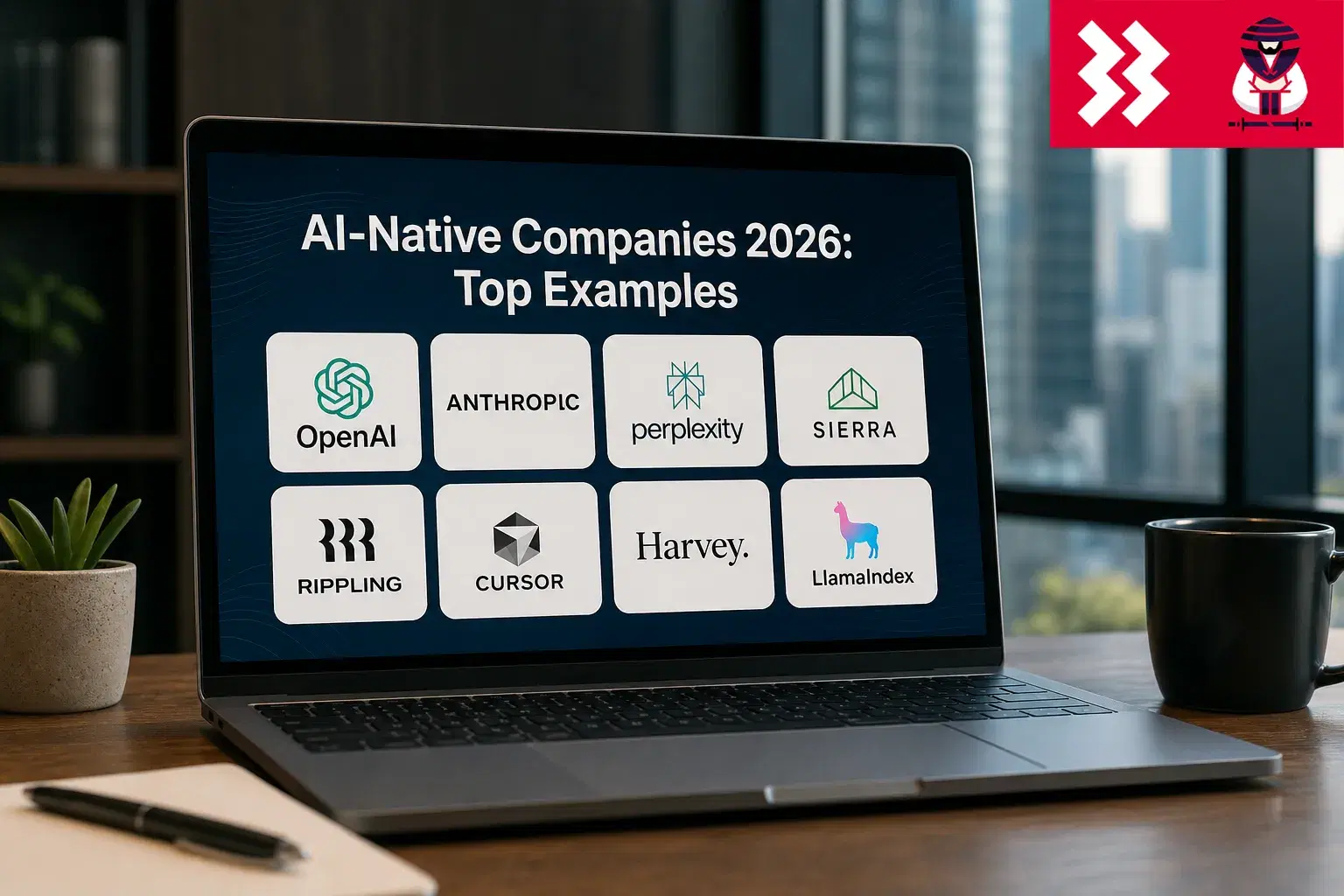
The strongest AI-native company examples in 2026 are not a single category. They include coding agents, AI IDEs, autonomous software engineers, app builders, and enterprise-controlled model platforms. CTOs should study them as patterns: each shows how AI-native engineering services can change delivery, governance, or product development.
This list is not a financial ranking. It is a practical landscape of companies and products that illustrate where AI-native engineering services are heading.
| Company or product | 2026 engineering pattern | CTO lesson |
|---|---|---|
| OpenAI Codex | Multi-agent coding across app, CLI, IDE, and cloud | Design for supervised agent teams |
| Anthropic Claude Code | Agentic coding from terminal and IDE | Treat AI coding as workflow redesign |
| Cognition Devin | Autonomous software engineering agent | Use agents for scoped, reviewable work |
| Cursor by Anysphere | AI-native coding environment | Bring AI into daily developer flow |
| GitHub Copilot | Agentic pull-request workflow | Keep review and checks inside SDLC |
| Replit Agent | Full-stack idea-to-app environment | Useful for prototypes and internal tools |
| Lovable | Natural-language app building | Democratise software creation with controls |
| Google Jules / Antigravity | Asynchronous and agent-first development | Separate agent management from editing |
| Poolside | Enterprise-controlled coding models | Prioritise governance for sensitive code |
OpenAI Codex is a clear example of agentic engineering moving beyond code completion. According to OpenAI (published 28 April 2026), more than 4 million people used Codex weekly, and teams used it to write code, explain systems, refactor applications, generate tests, modernise legacy codebases, and support broader professional workflows. OpenAI’s Codex product page also describes parallel agents, reusable cloud environments, pull-request review, IDE integration, CLI usage, and ChatGPT integration. (openai.com)
Anthropic Claude Code shows a different pattern: agentic coding embedded into developer tools. Anthropic introduced Claude Code as a limited research preview on 24 February 2025, describing it as a command-line tool that could search and read code, edit files, write and run tests, commit and push to GitHub, and use command-line tools. Anthropic later said, in a 3 December 2025 announcement, that Claude Code became generally available in May 2025 and reached $1 billion in run-rate revenue in six months; this is Anthropic’s self-reported commercial figure, not an independently audited benchmark. (anthropic.com)
Cognition’s Devin represents the “AI software engineer” model. According to Cognition (27 May 2026 announcement), Devin enterprise usage had grown more than 10x since the start of 2026, and run-rate revenue reached $492 million; Cognition also reported that 89% of code committed by its own engineers was committed by Devin, with the rest by local agents in Devin Desktop. Treat these as vendor-reported operating metrics, not a general benchmark for enterprise teams. (cognition.com)
Cursor by Anysphere illustrates the AI-native IDE pattern. According to Cursor’s Series C announcement (6 June 2025), the company raised $900 million at a $9.9 billion valuation and reported more than $500 million in ARR, with use by over half of the Fortune 500, including NVIDIA, Uber, and Adobe. Again, these are company-reported figures, but they show how quickly AI-first developer environments scaled. (cursor.com)
GitHub Copilot shows how incumbents are turning established SDLC platforms into agentic delivery systems. According to GitHub (25 September 2025), Copilot coding agent became generally available for paid Copilot subscribers and could implement features, fix bugs, address technical debt, improve test coverage, and update documentation through draft pull requests. GitHub then made the Copilot desktop app generally available for macOS, Windows, and Linux on 17 June 2026, describing it as a desktop home for agent-driven development. (github.blog)
Replit, Lovable, Google, and Poolside show the broader service opportunity. Replit Agent 4, announced 11 March 2026, emphasises full-stack building, parallel agents, design iteration, and production-ready apps within one environment. Lovable reported a $200 million Series A at a $1.8 billion valuation on 17 July 2025, then in August 2026 described established-company usage at Adidas, NVIDIA, and Deutsche Telekom; these are Lovable’s own examples. Google Jules became publicly available on 6 August 2025, while Google Antigravity 2.0, announced 19 May 2026, moved towards an agent-first platform separate from a traditional IDE. Poolside’s 2026 platform positioning focuses on enterprise control of model weights, auditability, telemetry, and predictable subscriptions for sensitive environments. (replit.com)
The pattern for CTOs is clear: no single provider covers every need. A credible AI-native engineering services strategy blends platform selection, secure delivery process design, software architecture, human review, and measurable business outcomes.
How will AI-driven engineering evolve beyond 2026?
Beyond 2026, AI-driven engineering will move from assistant-led development to managed agentic delivery. The winners will not be teams that generate the most code; they will be teams that combine AI agents with strong architecture, secure tool access, evaluation systems, regulatory readiness, and disciplined product governance.
Three forces will shape the next phase. First, agents will become more autonomous. Second, regulation will make traceability and accountability non-negotiable. Third, software delivery economics will shift from “developer hours” to “validated outcomes”.
For European CTOs, the EU AI Act is already part of this roadmap. According to the AI Act Service Desk (2026 enforcement FAQ), transparency obligations became applicable and enforceable from 2 August 2026, with a limited Article 50(2) marking-and-detection grace period to 2 December 2026 for providers of AI systems placed on the market before 2 August 2026. The same FAQ states that Annex III high-risk AI system rules apply from 2 December 2027 and high-risk AI systems embedded into regulated products apply from 2 August 2028. (ai-act-service-desk.ec.europa.eu)
This will affect AI-native engineering services in practical ways:
- Architecture documentation must be machine-readable and human-auditable.
- AI-generated code must be attributable, reviewable, and testable.
- Agent permissions must follow least-privilege principles.
- Model usage must be logged for security, cost, and compliance.
- Procurement must distinguish between GPAI providers, deployers, integrators, and downstream software suppliers.
Security will become more specialised. OWASP’s Top 10 for LLM Applications 2025 (published 17 November 2024) highlights the growth of security risks as LLMs are embedded into customer interactions and internal operations. The 2026 direction is even more agentic: prompt injection, excessive agency, data leakage, unsafe tool use, and supply-chain risk are now engineering concerns, not only AI research concerns. (genai.owasp.org)
Standards will also mature. ISO/IEC 42001:2023, published in December 2023, specifies requirements for establishing, implementing, maintaining, and continually improving an Artificial Intelligence Management System; ISO describes it as the world’s first AI management system standard. NIST’s AI Risk Management Framework, released on 26 January 2023, remains voluntary, but NIST states that it is intended to improve incorporation of trustworthiness considerations into AI design, development, use, and evaluation. (iso.org)
The opportunity for mid-sized companies is significant. They do not need to copy hyperscalers or frontier-model labs. They need a pragmatic AI-native engineering roadmap:
- Select two to three high-value engineering workflows such as test generation, legacy code analysis, internal tool creation, or documentation.
- Create an AI delivery policy covering data, prompts, repositories, secrets, acceptable tools, and review rules.
- Build evaluation suites for recurring engineering tasks.
- Introduce agents inside controlled environments with permissions, logs, and approval points.
- Measure outcomes such as lead time, escaped defects, review load, deployment frequency, and incident recovery.
- Scale only what improves system performance, not what merely increases code output.
This is where AI-native engineering services become strategic. A good partner helps you decide where AI should accelerate delivery, where human experts must remain in control, and where legacy systems require careful modernisation before agents can operate safely.
Discover how your company can leverage AI-native engineering services to remain competitive in the evolving landscape. Talk to us about where to start.
Sources
- Eurostat — “20% of EU enterprises use AI technologies”, published 11 December 2025. (ec.europa.eu)
- McKinsey & Company — “The State of AI: How organizations are rewiring to capture value”, published 12 March 2025. (mckinsey.com)
- DORA / Google Cloud — “State of AI-assisted Software Development 2025” and “Impact of Generative AI in Software Development”. (dora.dev)
- Stack Overflow — “Developers remain willing but reluctant to use AI”, 2025 Developer Survey results, republished 29 December 2025. (stackoverflow.blog)
- European Commission — AI Act regulatory framework and enforcement pages. (digital-strategy.ec.europa.eu)
- AI Act Service Desk — Enforcement timeline FAQ. (ai-act-service-desk.ec.europa.eu)
- OpenAI — Codex product page, Codex on AWS announcement, and Codex safety controls. (openai.com)
- Anthropic — Claude Code announcements and Claude Code commercial milestone. (anthropic.com)
- Cursor / Anysphere — Series C and scale announcement, 6 June 2025. (cursor.com)
- Cognition — Devin Series D / “More Devins in More Places” announcement, 2026. (cognition.com)
- GitHub — Copilot coding agent general availability and Copilot app general availability. (github.blog)
- Replit — “Introducing Replit Agent 4”, 11 March 2026. (replit.com)
- Google — Jules availability and Google Antigravity 2.0 announcements. (blog.google)
- Lovable — Series A and Series C announcements. (lovable.dev)
- Poolside — Poolside Platform announcement. (poolside.ai)
- OWASP — Top 10 for LLM Applications 2025. (genai.owasp.org)
- ISO — ISO/IEC 42001:2023 AI management systems. (iso.org)
- NIST — AI Risk Management Framework. (nist.gov)
FAQ
Frequently Asked Questions
Practical answers for CTOs evaluating AI-native engineering services in 2026.