MVP development in 2026 is not about shipping a cheap prototype; it is about building the smallest production-worthy product that proves a business case, protects users, and gives leadership evidence for the next investment decision. For European CTOs and VPs of Engineering, the winning MVP balances speed, compliance, architecture and customer learning from day one.
TL;DR / Key Takeaways
- A strong MVP validates one commercial hypothesis, one priority user journey and one scalable technical direction.
- Treat published market pricing as context, not a quote: Clutch’s 2026 software data is useful, but it is not an MVP-specific European benchmark.
- A focused B2B MVP usually needs a discovery sprint, a controlled build phase, production hardening and a post-launch learning cycle.
- Security, privacy, AI classification and software supply-chain decisions belong in discovery, not after the first pilot.
- Choose an MVP development company that can challenge scope, build production-grade foundations and support iteration after launch.
What should tech leaders understand about MVP development services?
MVP development services help companies turn a product hypothesis into a working, measurable first release. The service should combine product discovery, UX, architecture, engineering, quality assurance, DevSecOps and launch support. In 2026, the best providers do not simply “build features”; they reduce uncertainty before large-scale investment.
Eric Ries’ original definition remains useful: an MVP is the product version that enables the maximum amount of validated learning with the least effort. According to Eric Ries (published 3 August 2009), the point is learning from customers, not merely minimising the feature list. (startuplessonslearned.com)
For technology leaders, that distinction matters. A clickable prototype may test desirability, but it does not test operational readiness, security, integration complexity or whether a user will trust the product in a live workflow. A real MVP sits between throwaway validation and full product delivery.
A professional MVP development company should help define three boundaries before writing code:
- Business boundary: which assumption must be proven first?
- User boundary: which user journey must feel complete?
- Technical boundary: which architecture choices must survive scale, regulation and integration?
That boundary-setting is more important in 2026 because digital expectations are higher. According to Eurostat (published 3 February 2026, 2025 reference year), 53% of EU enterprises used paid cloud computing services in 2025, and Italy reached 75.6%; this shows that cloud-based delivery is now mainstream in European business technology, not an experimental choice. (ec.europa.eu)
AI also changes MVP expectations. According to Eurostat (published 11 December 2025, 2025 reference year), 20.0% of EU enterprises with at least 10 employees used AI technologies, up from 13.5% in 2024; however, that indicator measures enterprise AI use, not the development stage or safety of AI-enabled products. (ec.europa.eu)
For a mid-market company, MVP development services should therefore include practical governance: analytics design, backlog discipline, security controls, accessibility checks, cloud cost visibility and release management. The goal is not a “demo day” build. It is a controlled product experiment that can become a long-term platform if the evidence supports it.
How much does MVP development cost in 2026?
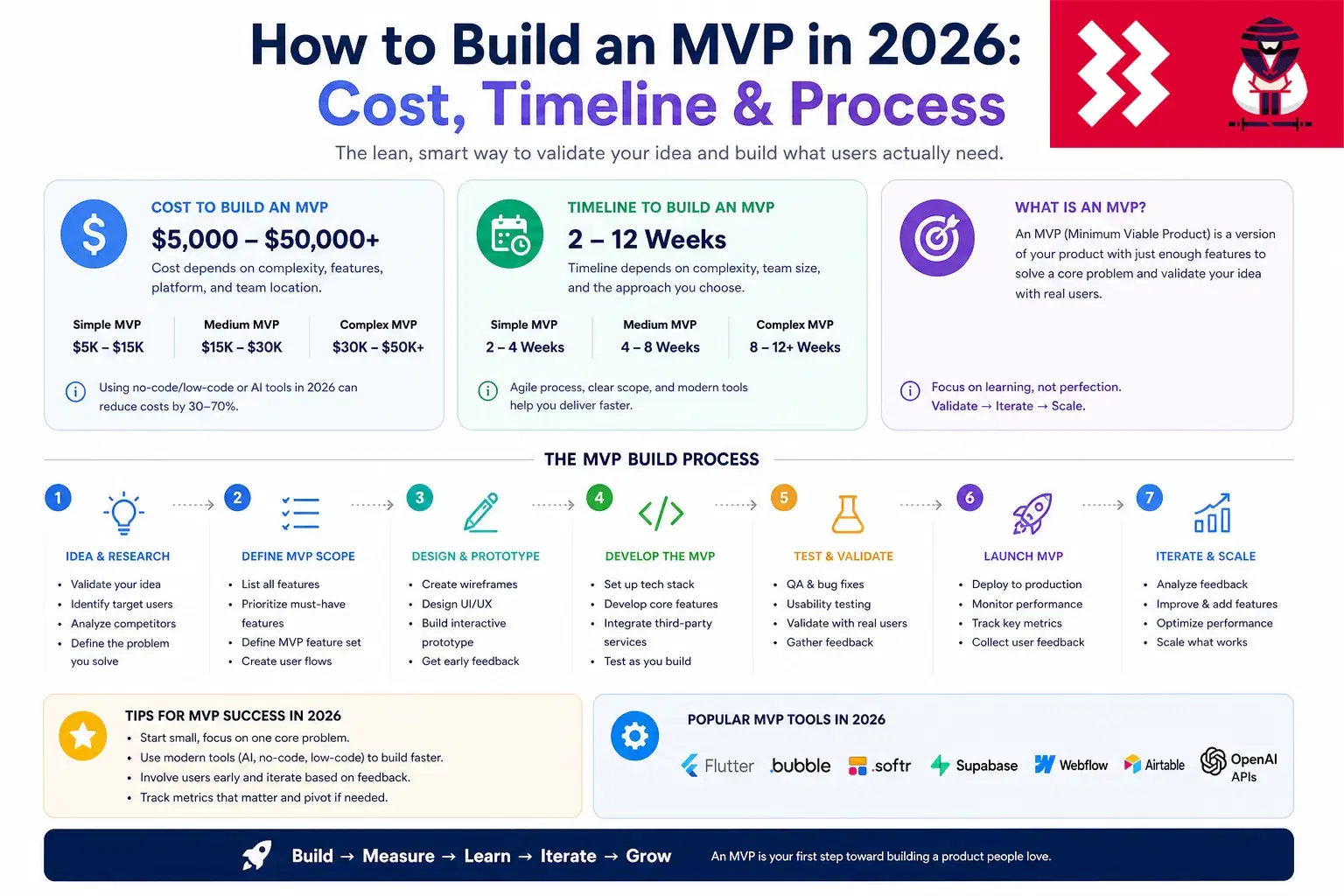
MVP development cost in 2026 depends on scope, integrations, compliance, team seniority, delivery model and post-launch support. A sensible estimate starts with validated scope hours, a blended delivery rate, contingency and a learning runway. The safest budget is not the lowest quote; it is the one tied to measurable outcomes.
Published market data gives useful context, but it must be read carefully. According to Clutch’s Software Development Company Pricing Guide (updated 21 September 2026, based on verified Clutch reviews), software development projects reviewed on Clutch typically cost $10,000–$49,999, the average project cost is $132,480.29, and the usual timeline is about 13 months. Clutch also reports that the average cost to hire a software development company ranges from $25–$49 per hour; this is global software development data, not an MVP-specific European benchmark. (clutch.co)
A practical MVP cost model should separate cost drivers from scope choices:
| Cost driver | What increases cost | How to control it |
|---|---|---|
| Product scope | Multiple user roles, dashboards and edge cases | Prioritise one primary workflow |
| Integrations | ERP, CRM, payments, identity and legacy APIs | Mock non-critical integrations first |
| Compliance | GDPR, AI, cybersecurity or sector rules | Run compliance discovery before build |
| UX complexity | Multi-device journeys and advanced interactions | Prototype and test before engineering |
| Data architecture | Reporting, audit logs and data migration | Define only decision-critical data |
| Quality level | Test coverage, security review and release automation | Automate repeatable checks early |
For planning, use ranges as hypotheses, not promises. A validation-heavy MVP with a narrow workflow may fit a modest budget. A B2B SaaS MVP with authentication, billing, analytics and admin controls needs more. A regulated workflow, AI feature, marketplace or enterprise integration can require a materially larger investment because risk is carried in architecture, testing and governance, not only in screens.
The simplest estimating formula is:
Estimated MVP cost = discovery + design + build hours + QA/security + deployment + 10–15% contingency + post-launch iteration runway.
That contingency is not padding. It protects the MVP from false economy: late API changes, data-quality issues, unexpected browser or device behaviour, and user feedback that forces a narrower but better first release.
Do not cut cost by removing QA, analytics or security. Cut cost by reducing scope. For example, launch with one customer segment, one pricing model, one language, one admin workflow and one measurable success metric. Reuse proven cloud services, design systems and authentication patterns where they do not weaken differentiation.
Privacy and security can also affect cost. GDPR Article 83(5) allows administrative fines up to €20 million or 4% of total worldwide annual turnover, whichever is higher; that does not mean every MVP carries that exposure, but it does mean personal-data design should not be improvised in the final sprint. (eur-lex.europa.eu)
How long does it take to build an MVP?
A focused MVP typically needs weeks, not a full enterprise programme, but the real timeline depends on decision speed, scope discipline, integration readiness and regulatory risk. Plan around four phases: discovery, design, build, and launch learning. Compress meetings before you compress engineering quality, testing or release controls.
Clutch’s 2026 custom software data reports a usual project timeline of about 13 months for software projects reviewed on its platform; that figure should not be treated as an MVP benchmark, but it shows how quickly custom software expands when scope, stakeholders and integration complexity grow. (clutch.co)
For MVP development 2026 planning, use this delivery pattern:
| Phase | Typical focus | Decision output |
|---|---|---|
| Discovery | Problem, users, assumptions, risks | MVP hypothesis and scope boundary |
| UX and architecture | User journey, data model, technical approach | Build-ready backlog |
| Build sprints | Core workflow, integrations, QA | Working product increments |
| Hardening | Security, performance, analytics, deployment | Release candidate |
| Launch learning | Pilot users, metrics, feedback | Pivot, persevere or stop decision |
The timeline usually slips for predictable reasons. Stakeholders add “essential” features after discovery. API documentation is incomplete. Legal review starts too late. A pilot customer asks for a security questionnaire. The team confuses demo completeness with production readiness.
Strong timeline planning starts with a single success metric. Examples include “five pilot customers complete onboarding without support”, “operations team reduces manual case handling”, or “qualified users return twice within two weeks”. The metric drives scope. If a feature does not help measure the hypothesis, it belongs in the post-MVP backlog.
Engineering practices matter. According to Google Cloud’s DORA documentation (accessed September 2026), DORA identifies capabilities such as continuous delivery, continuous integration, test automation, database change management and deployment automation as software delivery capabilities that help teams improve delivery and organisational performance. (docs.cloud.google.com)
AI-assisted delivery can accelerate parts of coding, testing and documentation, but it does not remove the need for architecture and review. According to Google Cloud’s DORA 2025 material, AI acts as an amplifier of existing organisational strengths and weaknesses, with value depending on the surrounding team system rather than tools alone. (dora.dev)
The practical lesson is simple: protect the feedback loop. Run weekly product reviews, keep a visible risk register, freeze the MVP scope after discovery unless evidence changes, and schedule post-launch iteration before the launch date. An MVP that ships without learning capacity is only an unfinished product.
What is the step-by-step MVP development process?
The MVP development process starts with a validated problem and ends with evidence for the next investment decision. A robust process covers discovery, prioritisation, UX, architecture, secure development, testing, launch and measurement. In 2026, compliance and operational readiness must run through every step, not sit outside delivery.
A practical process for European B2B products looks like this:
-
Define the product hypothesis. State the target user, painful problem, promised outcome and commercial assumption. If the hypothesis cannot be written in one paragraph, the MVP is probably too broad.
-
Research users and buying context. Interview users, economic buyers, administrators and support teams. In B2B, the person who uses the product is not always the person who approves it.
-
Map the critical journey. Build only the journey that proves value. For an internal workflow tool, that may be intake, review and approval. For SaaS, it may be sign-up, activation and one repeatable task.
-
Prioritise with risk, not opinion. Rank backlog items by learning value, technical dependency and user impact. Avoid prioritising by seniority in the room.
-
Design architecture and compliance controls. Select the cloud pattern, data model, identity approach, audit requirements and integration strategy. If the MVP includes AI, classify the use case early. Regulation (EU) 2024/1689, the EU AI Act, uses staged application dates, with the general application date set at 2 August 2026 under Article 113; AI classification should therefore be a discovery activity, not a launch checklist. (ai-act-service-desk.ec.europa.eu)
-
Build in short, reviewable increments. Use sprint demos that show working software, not status slides. Maintain a clear definition of done covering code review, tests, accessibility basics, logging and deployment readiness.
-
Test for behaviour, security and reliability. Functional QA is not enough. Use threat modelling, dependency checks and role-based access tests. ISO/IEC 27001:2022 defines requirements for an information security management system and frames information security around confidentiality, integrity and availability. (iso.org) OWASP SAMM provides an open framework for analysing and improving software security practices across the software lifecycle. (owasp.org)
-
Launch to a controlled audience and measure. Release to a defined pilot group with analytics, support paths and feedback capture. Do not launch broadly until onboarding, incident handling and data visibility are ready.
For products with digital elements, the Cyber Resilience Act is now part of the strategic backdrop. Regulation (EU) 2024/2847 applies from 11 December 2027, with reporting obligations for actively exploited vulnerabilities and severe incidents applying from 11 September 2026, and conformity assessment body provisions applying from 11 June 2026. (eur-lex.europa.eu)
NIS2 can also affect buyers in essential or important sectors. European Commission guidance on NIS2 Article 21 states that cybersecurity risk-management measures refer to all operations and services of the entity concerned, not only selected IT assets. (eur-lex.europa.eu)
A good MVP process ends with a board-level decision: persevere, pivot, extend, pause or retire. That decision should be based on usage data, customer feedback, support load, technical findings and commercial signal — not optimism.
How do you choose the right MVP development company?
Choose an MVP development company that can reduce risk before it writes code. The right partner challenges assumptions, designs for production, explains trade-offs, and measures outcomes after launch. For European leaders, experience with GDPR, cloud architecture, cybersecurity and regulated B2B workflows is as important as engineering capacity.
Start by evaluating the partner’s discovery discipline. A serious provider will ask about the business model, user evidence, integration landscape, data sensitivity, procurement constraints and success metrics. If a vendor moves directly from idea to fixed feature list, it may optimise for output rather than learning.
Use marketplaces carefully. Clutch’s 2026 pricing guide is useful for understanding market bands, but its own figures cover reviewed software development projects broadly; they do not replace a scope-specific estimate, technical discovery or contract-level delivery plan. (clutch.co)
| Partner model | Best fit | Watch-outs |
|---|---|---|
| Freelancers | Narrow prototype or specialist task | Coordination, continuity and QA gaps |
| Temporary team expansion | Mature internal product team needs capacity | Product ownership remains with you |
| MVP development company | End-to-end discovery, build and launch | Validate methods, references and seniority |
| Large consultancy | Complex enterprise transformation | Higher overhead and slower decisions |
Ask potential partners these questions:
- What assumptions would you test before building?
- Which features would you remove from this MVP?
- How do you handle GDPR, AI classification and security-by-design?
- What does your definition of done include?
- Who owns architecture decisions and technical debt?
- How do you measure launch success?
- What happens in the first 90 days after release?
The strongest answers will be specific. Look for a team that can show product thinking, engineering pragmatism and delivery governance in the same conversation. A CTO should be able to discuss event architecture, user onboarding, test strategy and commercial validation without being passed between disconnected specialists.
Also check whether the partner can work with your internal constraints. Mid-sized European organisations often have legacy systems, procurement gates, sector-specific obligations and security reviews. A good MVP partner plans around those realities rather than treating them as late-stage blockers.
Finally, assess cultural fit. MVP development requires honest conversations about what not to build. You need a partner comfortable saying “no” to low-value features and “yes” to the foundations that protect future scale: clean architecture, observable systems, secure access control, maintainable code and a measurable learning loop.
For WWG clients, that means treating MVP development as a strategic product engagement, not a temporary coding sprint. The outcome should be a first release that users can trust, stakeholders can evaluate and engineering teams can extend without starting again.
Contact us to learn how our expert MVP development services can help bring your product vision to life efficiently and cost-effectively.
Sources
- Eric Ries, “Minimum Viable Product: a guide”, published 3 August 2009 — https://www.startuplessonslearned.com/2009/08/minimum-viable-product-guide.html (startuplessonslearned.com)
- Clutch, “Software Development Company Pricing Guide 2026”, updated 21 September 2026 — https://clutch.co/developers/pricing (clutch.co)
- Eurostat, “53% EU enterprises used paid cloud services in 2025”, published 3 February 2026 — https://ec.europa.eu/eurostat/web/products-eurostat-news/w/ddn-20260203-1 (ec.europa.eu)
- Eurostat, “20% of EU enterprises use AI technologies”, published 11 December 2025 — https://ec.europa.eu/eurostat/web/products-eurostat-news/w/ddn-20251211-2 (ec.europa.eu)
- Google Cloud, DORA DevOps capabilities documentation — https://docs.cloud.google.com/architecture/devops (docs.cloud.google.com)
- DORA, “State of AI-assisted Software Development 2025” — https://dora.dev/research/2025/dora-report/ (dora.dev)
- EUR-Lex, General Data Protection Regulation, Regulation (EU) 2016/679, Article 83 — https://eur-lex.europa.eu/legal-content/EN/ALL/?uri=celex:32016R0679 (eur-lex.europa.eu)
- EU AI Act Service Desk, Regulation (EU) 2024/1689, Article 113 — https://ai-act-service-desk.ec.europa.eu/en/ai-act/article-113 (ai-act-service-desk.ec.europa.eu)
- EUR-Lex, Cyber Resilience Act, Regulation (EU) 2024/2847 — https://eur-lex.europa.eu/legal-content/EN/TXT/?uri=celex:32024R2847 (eur-lex.europa.eu)
- European Commission guidance on NIS2 Article 21 — https://eur-lex.europa.eu/legal-content/EN/TXT/PDF/?uri=OJ:JOC_2023_328_R_0002 (eur-lex.europa.eu)
- ISO, ISO/IEC 27001:2022 information security management systems — https://www.iso.org/standard/27001 (iso.org)
- OWASP Foundation, OWASP Software Assurance Maturity Model — https://owasp.org/projects/samm (owasp.org)
FAQ
Frequently Asked Questions
Clear answers to common MVP development questions for technology leaders planning a product launch.