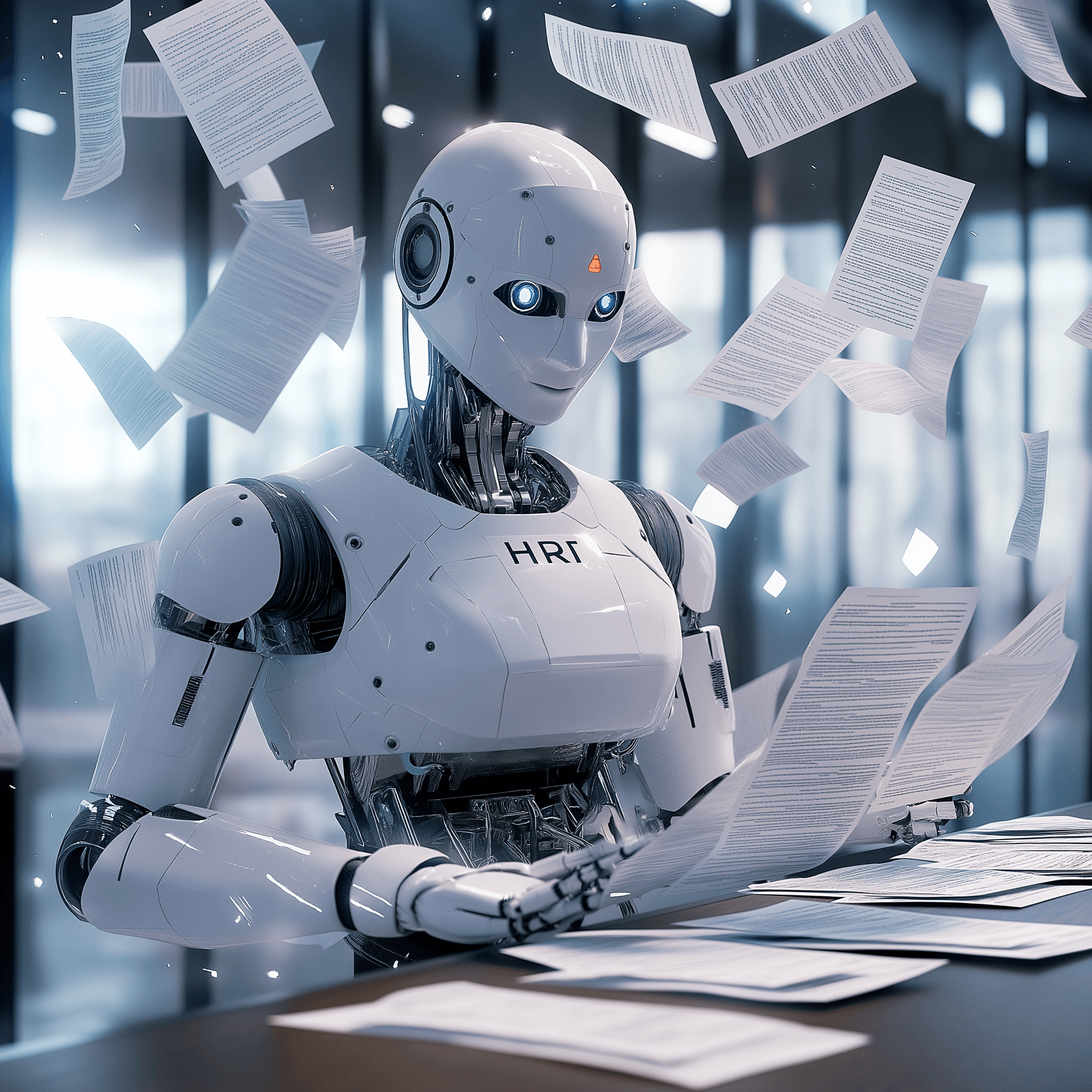
An AI worker is a software agent that takes over a complete role-sized piece of work, not a single task: it reads the inputs, decides the steps, uses the company's tools and delivers an outcome a person can check, such as a project set up and ready for the team, a lead qualified and followed up, or a new hire onboarded. WWG built its first one in late 2024, the AI Product Owner, which replaced two to three weeks of project preparation with a few minutes of automated work. This article, published in April 2025 and updated in 2026, tells how it works, what it produced, what has changed since with agentic AI and the EU AI Act, and how a company can introduce an AI worker without losing control of it.
TL;DR
- Before the AI Product Owner, every signed contract at WWG triggered two to three weeks of preparation: reading the brief, breaking it into tasks, writing documentation, setting up tools and channels.
- The AI Product Owner does the whole pre-development cycle in minutes when a project enters the CRM: analysis, task breakdown, documentation, a Jira board, Slack channel and team notification.
- As measured in 2025 across fifteen client and internal projects, project launch costs fell by about 60% and kick-offs moved from weeks to the same day.
- Since then the model has become agentic by design: tools called through defined interfaces, a human approval step before anything reaches the client, and logs for every decision.
- The EU AI Act, in force since 2024 with obligations phased in through 2026 and 2027, makes governance, transparency and human oversight requirements rather than good practice.
What problem did the AI Product Owner solve?
It solved the gap between a signed contract and the first line of code. Until late 2024, every new client contract at WWG triggered a frustrating cycle: payment arrived, and then a project manager spent two to three weeks digging into the brief, gathering requirements, writing documentation, creating the Jira board, setting up communication channels and briefing the team. Time slipped, budgets stretched, and developers waited.
So we asked ourselves why not build an AI employee to handle this chaos, and we built the AI Product Owner: a digital teammate that handles the entire pre-development cycle in three to four minutes. It is not a chatbot; it is a workflow of models and tools wired to the systems we already use, with the outcome checked by a person before the team starts.
How does the AI Product Owner work?
Everything starts when a new project is added to the CRM. That event triggers an automated process in which the AI analyses the business requirements, breaks the project into components and technical tasks, generates the documentation, builds the Jira board and sets up the communication channels, then notifies the team.
| Step | What the AI worker does | What a person checks |
|---|---|---|
| Analyse requirements | Reads the client brief, technical specifications, call transcripts and attachments to understand goals, core functionality and expectations | That the understanding matches the sale |
| Break down the project | Translates business language into epics, user stories and detailed technical tasks | Scope and priorities |
| Generate documentation | Product specification, technical architecture, kick-off brief and estimates, created from the real inputs rather than templates | Estimates and assumptions |
| Build the Jira board | User stories, tasks, deadlines, priorities and role assignments, fully structured | Deadlines against the contract |
| Set up communication | Creates the Slack channel, tags the right people and opens the conversation | Nothing, unless the client is invited |
| Track progress | Syncs with daily updates and raises flags when something goes off track | The flags |
The quality matches what a senior team would deliver; the difference is that it is done in minutes rather than weeks, and developers start coding the same day the contract is signed. The approval column in the table is the part that was implicit in 2025 and is explicit now: every artefact that leaves the system passes a person before it reaches a client.
What results did WWG measure?
As measured in 2025, the AI Product Owner had been used on fifteen projects, including internal tools such as AI Lab and client platforms, and ten of WWG's own projects had been launched this way. Three results stood out: project launch costs fell by about 60%, because far less was spent on early planning, documentation and coordination; kick-offs moved from weeks to same-day starts, because everything the developers needed was ready before they opened their laptops; and team members were freed from templating documents and organising calls to do the work they are good at.
These are WWG's own operational figures, measured on its own projects, and they depend on the kind of work we do: software projects with a written brief and a known delivery process. A company with messier inputs will see smaller gains at first, which is why the first step of any AI worker project is the process analysis described below.
What has changed since 2025?
Two things: the technology and the rules. On the technology side, the pattern we built by hand in 2024 has become the standard way of building agents: models that call tools through defined interfaces, keep a plan, check their own output and ask for approval at defined points. This made AI workers more reliable and cheaper to build, and it extended the roles they can cover.
| Role | What an AI worker covers today |
|---|---|
| Product management | Roadmaps, Jira boards, deadline monitoring, alignment from day one |
| Project management | Coordination, meeting organisation, early risk flags |
| HR processes | Onboarding, document preparation, support for new hires |
| Customer support | Instant, consistent answers around the clock, with escalation to people |
| Sales | Lead research and qualification, personalised outreach, follow-ups and meeting booking, as in our AI workers for sales and marketing |
On the rules side, the EU Artificial Intelligence Act entered into force in 2024, with obligations phased in through 2026 and 2027: transparency when people interact with an AI system, documentation and risk management for high-risk uses, and human oversight. Most AI workers in a software company fall outside the high-risk categories, but the discipline the Act asks for, logging decisions, keeping a person accountable, telling people when they are dealing with an AI, is the same discipline that makes an AI worker safe to run. (digital-strategy.ec.europa.eu)
How can a company introduce an AI worker?
In three steps: analyse the current process to find what is repetitive, manual and safe to automate; build a custom AI worker for that process, wired to the company's own tools and with approval points defined; train the team and keep tuning it together. An AI worker is not here to replace people but to support them: while employees focus on creativity, strategy and decisions, it handles the routine, quietly, accurately and instantly.
The order matters. Companies that start from the tool and look for a use rarely get past a demo; companies that start from a measured process, such as the two to three weeks of project preparation we started from, get a result they can compare. How to measure that result is the subject of our guide to AI ROI, and how to connect an AI worker to the systems a company already runs is the subject of our guide to integrating AI into existing enterprise software. The smaller first steps, from inbox sorting to meeting summaries, are in our article on micro-automations.
Want to see which of your processes an AI worker could take over? Talk to a WWG engineer at business@wwg.it.
Sources
FAQ
Frequently Asked Questions
A software agent that takes over a role-sized piece of work rather than a single task: it reads the inputs, decides the steps, uses the company's tools and delivers an outcome a person checks, such as a project set up for the team or a lead qualified and followed up. It differs from a chatbot in that it acts inside the company's systems, not just in a conversation.
When a project enters the CRM it analyses the brief and attachments, breaks the project into epics, user stories and tasks, generates the specification, architecture, kick-off brief and estimates, builds the Jira board, creates the Slack channel and notifies the team, in a few minutes. A person reviews the output before the team starts and before anything reaches the client.
As measured in 2025 on fifteen projects, project launch costs fell by about 60%, kick-offs moved from two to three weeks to the same day, and team members were freed from documentation and coordination work. The figures are WWG's own and depend on having a written brief and a known delivery process.
No. They take over the repetitive, manual parts of a role so that people can focus on creativity, strategy and decisions, and they work under human approval at defined points. In practice they let a team do more without extra hires or overtime, and they create new work: someone has to own, tune and supervise each AI worker.
Transparency when people interact with an AI system, risk management and documentation for uses classified as high-risk, and human oversight, with obligations phased in through 2026 and 2027. Most AI workers in a software company are not high-risk, but logging decisions, keeping an accountable owner and telling people when they are dealing with an AI are good practice in every case.