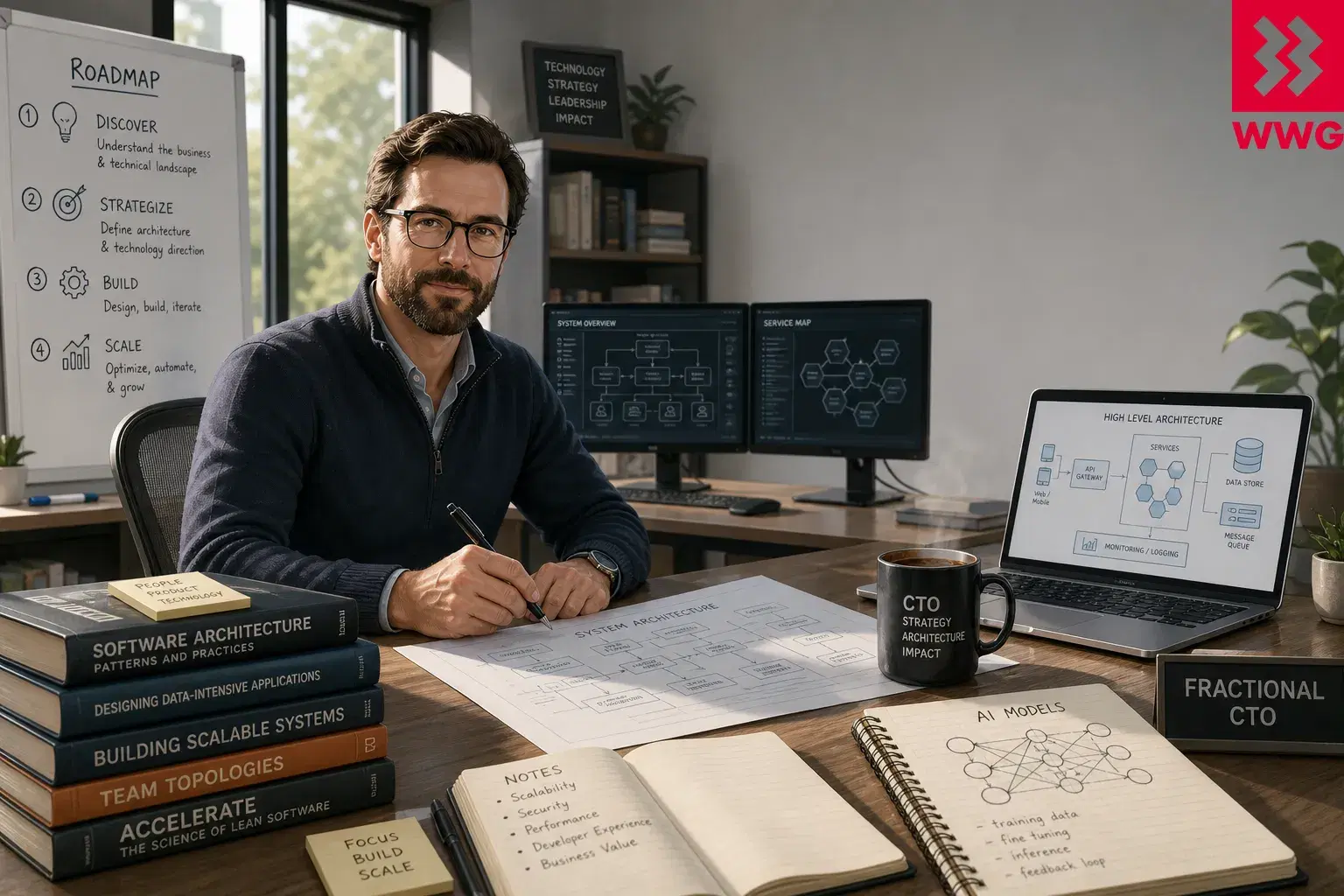
In brief. The three titles are often used as if they meant the same thing, and in many Italian companies one person holds all three. They answer different questions. The CIO is responsible for the information systems the company runs on: ERP, networks, data, security, suppliers. The CTO is responsible for the technology the company builds or sells, and for whether the technical choices behind it are right. The VP of Engineering is responsible for the team that builds it: hiring, process, delivery. This guide explains each role using the official European definitions where they exist, shows what the roles cost in Italy, and helps you decide which one your company actually needs. For many traditional SMEs, hiring a full-time CTO, CIO or VP of Engineering may be unnecessary. What matters is having clear ownership of the technology decisions the business actually needs.
Why the titles get confused
Even the official classifications blur the line. ESCO, the European Commission’s classification of occupations, is not a formal organisational standard: it is the EU’s reference list of occupations and job titles. It lists “IT director” as an alternative name both for the chief technology officer and for the chief information officer. The European ICT Professional Role Profiles (CWA 16458-1:2018), the CEN reference for 30 ICT roles, contain a CIO profile but no CTO profile, and no profile for engineering management. Its user guide maps the ESCO occupation “chief technology officer” onto the CIO profile. This does not mean that the CTO and the VP of Engineering are not distinct jobs. It means these references were not designed to draw the line between them, and the overlapping titles are a reason to look beyond titles and define responsibilities explicitly.
So there is no single legal or standard definition that settles the question, and job titles vary from company to company. What does exist is a fairly stable practical split, which the definitions below support: one role looks after the systems the business uses, one after the technology the business makes, and one after the people who make it.
The CIO: the systems the company runs on
ESCO defines chief information officers as the people who “define and implement the ICT strategy and governance”. They decide what resources that strategy needs, anticipate changes in the ICT market and in business needs, contribute to the company’s strategic plan, and make sure the ICT infrastructure supports operations. The European role profile adds the operational side: the CIO ensures the reliability, confidentiality, security and integrity of information systems, manages contracts and relationships with ICT suppliers, and is measured on the overall added value, efficiency and effectiveness of the information system.
In practice, the CIO’s world is internal. ERP and CRM, the network, email and devices, data and backups, licences and supplier contracts, cybersecurity policy. In a manufacturing company that sells through distributors, this is most of the technology there is.
The role is increasingly a business role. In Foundry’s State of the CIO 2026, a global survey of 662 IT leaders and 249 business-line respondents, 40% of the IT leaders surveyed report directly to the CEO, down from 48% the year before; in EMEA the share is 44%. 82% of IT leaders say they are tasked with researching and evaluating possible AI additions to the technology stack. The top priority CEOs set for IT leaders is researching and implementing AI, cited by 27%, followed by upgrading IT and data security, cited by 25%.
The CTO: the technology the company builds
ESCO describes chief technology officers as the people who “contribute to a company’s technical vision and lead all aspects of technology development”, in line with its strategy and growth objectives, matching technology with business needs. The key word is development. A CTO matters when software is part of what the company sells or how it competes: a digital product, a customer portal, a platform, a custom system that gives the business an edge. In Italian manufacturing, the CTO is also easy to confuse with the direttore tecnico or the responsabile dell’ufficio tecnico. Those titles traditionally lead product engineering, drawings and production technology, not software.
The role takes different shapes. Werner Vogels, CTO of Amazon, described four in 2007: the infrastructure manager, who runs IT operations where technology is a support function; the technology visionary and operations manager, often a co-founder, who decides how technology serves the strategy and then builds and runs it; the external-facing technologist, who links customers and the development team; and the big thinker, who looks for new business models and oversees research and architecture standards. The first type is close to what this guide calls a CIO. The other three are what most people mean by CTO today.
The CTO’s core output is decisions: architecture, technology stack, build or buy, which vendors to trust, when to rewrite or refactor a system. A good CTO can explain those decisions, and their cost and risk, to a board that is not technical.
The VP of Engineering: the team that builds it
There is no ESCO occupation or European role profile for the VP of Engineering, so the best descriptions come from practitioners. Venture capitalist Fred Wilson put the split simply in 2011: the CTO makes sure the technical approach is right, the VP of Engineering makes sure the team is right. In his description the VP of Engineering is first of all a manager and team builder who recruits well, communicates clearly and removes whatever blocks the engineering organisation. The CTO is ideally the strongest technologist in the company. Wilson notes that one person rarely excels at both, because the jobs need different skills and a different use of time.
Brad Feld, another venture investor, wrote in 2007 that in startups one person often covers both roles until the company reaches about 20 people, after which they should be split. The VP of Engineering owns process and shipping; the CTO owns technical vision, prototypes and explaining the technology outside the team. Both authors write about startups, and these are classic rules of thumb rather than standards. There is no universal headcount at which the two roles should split. The decision depends more on the size of the engineering team, the complexity of the organisation and how much time people management takes compared with technical strategy. Titles also vary: in many European companies the same job is called Head of Engineering or Engineering Director.
The three roles side by side
| CIO | CTO | VP of Engineering | |
|---|---|---|---|
| Main question | Do our systems support the business, safely and efficiently? | Is our technology the right one to build, sell and compete with? | Is the team delivering, and is it the right team? |
| Typical decisions | Which ERP and suppliers? What security policy? How much to spend on infrastructure? | Which architecture? Which technology stack? What to build, buy or modernise? Which technical risks to accept? | How to organise development? How to hire and grow engineers? How to make releases predictable? How to improve delivery? |
| Looks at | Internal systems, data, infrastructure, suppliers | Product technology, architecture, technical strategy | People, hiring, process, delivery |
| Typical output | ICT strategy and governance, budget, supplier contracts, security policy | Technical roadmap, architecture and stack decisions, build or buy choices | Hiring plan, delivery process, release cadence, team structure |
| Measured on | Value, efficiency and effectiveness of the information system | Whether the technology choices hold up as the business grows | Whether the team ships reliably and keeps its people |
| Where the definition comes from | ESCO and European ICT role profile (CWA 16458) | ESCO; no European role profile | Practitioners only (Wilson, Feld) |
The table is our summary of the sources cited above. Where a cell goes beyond them, it reflects common practice rather than a formal definition.
And the CISO?
A fourth title appears more and more often next to these three. ESCO describes the chief ICT security officer (CISO) as the person who protects company and employee information against unauthorised access, defines the security policy of the information system and manages its deployment. Organisational models vary. Some companies have a dedicated CISO; in others the CIO covers the role, and Foundry found that CIOs hold on average 1.6 positions, including titles such as CISO and chief AI officer. In practice security work is often shared: the CISO or another designated security professional owns policy and risk, the CIO owns the security of infrastructure and operations, and the CTO owns the security of the product and its architecture.
For Italian companies subject to NIS2 this matters, but it does not move the final responsibility. For essential and important entities, Article 23 of Legislative Decree 138/2024 makes the administrative and management bodies approve the security measures, oversee them and answer for violations. A CISO, a CIO or a CTO executes; the board remains accountable. What this means for old software is covered in our guide to NIS2 and legacy software.
Which role does an Italian SME need?
Start from the numbers. According to Eurostat, in 2024 only 7.9% of Italian enterprises with 10 to 49 employees employed any ICT specialist at all, against 14.0% in the EU. Among companies with 50 to 249 employees the share was 38.8% (EU 43.0%), and among those with 250 or more, 74.6% (EU 78.4%). In the same year only 3.0% of all Italian enterprises with 10 to 49 employees recruited or tried to recruit an ICT specialist. More than nine out of ten Italian small enterprises do not employ an ICT specialist internally. Many rely on external providers instead, which makes clear ownership of technology decisions even more important.
That does not mean the responsibilities disappear. Someone still decides which ERP to buy, which agency builds the customer portal and whether the old system can stay. The useful question is therefore not which title to hire, but which responsibility you are missing. Three situations cover most cases.
- You use software but do not build it. Your technology is ERP, office systems, network, a website, a few cloud services. You need CIO-type ownership: someone who keeps systems reliable and secure, manages suppliers and plans spending. In many SMEs this is an IT manager supported by external providers, not a C-level role.
- Software is part of your product or your edge. You sell a digital service, run a customer or partner portal, or commission custom systems from more than one vendor. You need CTO-type ownership: someone who makes and defends the technical decisions. If you do not have enough of these decisions to fill a full-time job, a fractional CTO covers the role for a few days a month.
- You have an in-house development team that is growing. Once the team is large enough that delivery, hiring and process take most of the senior person’s time, that work becomes a job of its own: VP of Engineering or Head of Engineering. There is no fixed headcount for this step. Until then, a technical lead plus a CTO, or an external team through team augmentation, is usually enough.
The situations can overlap, and one person can cover two roles for a while. The risk is hiring for the wrong one: a strong engineering manager will not fix a vendor strategy, and a visionary CTO will not want to run backups and licence renewals.
What the roles cost in Italy
Michael Page’s salary study 2026 (PDF, pages 22 and 23) gives these bands in euro. They are gross annual base salaries (RAL); the bonus is shown separately, as a percentage.
| Role in the study | Under 5 years | 5 to 10 years | Over 10 years | Bonus |
|---|---|---|---|---|
| CTO (software development and ERP) | 60,000-80,000 | 80,000-100,000 | over 100,000 | 10-30% |
| IT Director (IT governance) | not listed | 60,000-100,000 | over 100,000 | 10-30% |
| CISO (security and GDPR) | 70,000-80,000 | 80,000-100,000 | over 100,000 | 0-20% |
These figures are indicative benchmarks, not exact equivalents for each executive role. The study has no separate CIO line, so the IT Director range serves as a proxy, and it has no benchmark for the VP of Engineering at all. Actual pay depends on company size, location, responsibilities and industry. For an Italian employer the salary is also not the full cost: the costo aziendale (total cost to the company) adds social security and insurance contributions, the TFR severance accrual and any benefits, and recruitment fees and the months it takes to find a senior profile come on top. For a company that needs CTO decisions a few days a month rather than every day, a fractional arrangement is priced on the days committed; our fractional CTO guide gives market rates with sources.
An example: who owns what in an 80-person manufacturer
Take a hypothetical company (not a WWG client) with 80 employees that makes industrial components. It runs an ERP from a software vendor, a network and a handful of cloud services. Two years ago it commissioned a B2B portal for its distributors from an external agency, and the portal now has to talk to the ERP in real time.
The CIO-type responsibilities are clear: the ERP contract, backups, access rights, the network, supplier management and, if the company falls under NIS2, the basic security measures. An internal IT manager can own these. The CTO-type responsibilities are the portal: its architecture, the integration with the ERP, whether the agency’s estimates make sense, what to build next and whether to keep the agency. Nobody in the company owns these today, and the consequences are familiar. The integration has been “almost done” for six months. The agency revises its estimate every few weeks. Nobody inside can say whether the cause is the architecture, the ERP’s interfaces or the agency’s delivery. The portal developers and the ERP integrator bill hours for meetings in which each blames the other, and the general manager approves invoices with no way to judge them. A VP of Engineering is not needed: there is no internal development team to manage.
The sensible set-up for this company is an IT manager for the systems and an external CTO for the portal decisions, a few days a month, with a written roadmap that the general manager can read.
Sources
All sources were opened and read on 3 November 2026.
- ESCO, occupation “chief technology officer”: definition of the CTO; “IT director” listed as an alternative label. esco.ec.europa.eu
- ESCO, occupation “chief information officer”: definition of the CIO; “IT director” listed as an alternative label. esco.ec.europa.eu
- ESCO, occupation “chief ICT security officer”: definition of the CISO. esco.ec.europa.eu
- CEN, CWA 16458-1:2018, European ICT Professional Role Profiles: 30 profiles; CIO profile; no CTO or engineering management profile. cencenelec.eu (PDF)
- CEN, CWA 16458-2:2018, user guide: ESCO “chief technology officer” mapped to the CIO profile. itprofessionalism.org (PDF)
- Eurostat, isoc_ske_itspe (updated 15 June 2026): enterprises employing ICT specialists by size class, Italy and EU, 2024. ec.europa.eu/eurostat
- Eurostat, isoc_ske_itrcrs (updated 15 June 2026): enterprises that recruited or tried to recruit ICT specialists, Italy, 2024. ec.europa.eu/eurostat
- Legislative Decree 138/2024, Art. 23 (Normattiva): responsibilities of administrative and management bodies under NIS2. normattiva.it
- Foundry, State of the CIO Study 2026: reporting lines, AI evaluation, CEO priorities, positions held by CIOs; sample 662 IT leaders and 249 business-line respondents. foundryco.com (PDF)
- Michael Page, Studi di retribuzione 2026, pp. 22-23: salary bands for CTO, IT Director, CISO. michaelpage.it, PDF
- Werner Vogels, “The different CTO roles”, 11 July 2007 (practitioner): four types of CTO. allthingsdistributed.com
- Fred Wilson, “VP Engineering Vs CTO”, 31 October 2011 (practitioner): the CTO owns the technical approach, the VP of Engineering owns the team. avc.com
- Brad Feld, “CTO vs. VP Engineering”, 14 October 2007 (practitioner): one person often covers both roles in early startups. feld.com
FAQ
Frequently asked questions
Short answers on how the CTO, CIO and VP of Engineering differ, what a CTO costs in Italy and who owns cybersecurity.