When you buy a company that runs on software, you also buy its code, its technical debt and its vulnerabilities. None of them appear on the balance sheet. The business plan usually assumes they have been dealt with.
Technical due diligence of software exists to show them before signing. This guide is a checklist for CEOs, investors, M&A advisers and CFOs: what gets checked, area by area, how the review runs, how long it takes, what the report should contain and which findings move the price. If you are looking for someone to carry it out, the service is described on our software audit and technical due diligence page. Here we explain the method, so you can read and challenge any report, including one that is not ours.
When you need technical due diligence
The question is always the same: is the software worth what the price assumes, and what will it cost to get it where the plan needs it? What changes is the occasion.
- Acquiring a company or a business unit. Software is often the main asset. A problem found after closing is the buyer's problem.
- An investment round. The investor wants to know whether the product can carry the growth it is funding, or whether part of the money will go into rebuilding the foundations.
- Taking over a supplier's software. When you change vendor or bring development in house, you inherit a system someone else wrote. It pays to know what is in it before you sign a new contract.
- Before a rewrite. Deciding to rebuild everything without measuring the current system is a bet. We cover that decision in Rewrite vs Refactor: A Decision Framework for Mid-Market CTOs.
The best-known example of what limited diligence can cost involves data. In 2020 the UK data protection authority, the ICO, fined Marriott £18.4m. The breach began in 2014 in the systems of Starwood, which Marriott acquired in 2016, and was only uncovered in 2018. It affected up to 339 million guests. Marriott said it had only been able to carry out limited due diligence before the acquisition. The penalty covered the period after GDPR took effect, but the problem had been bought along with the company.
The checklist, area by area
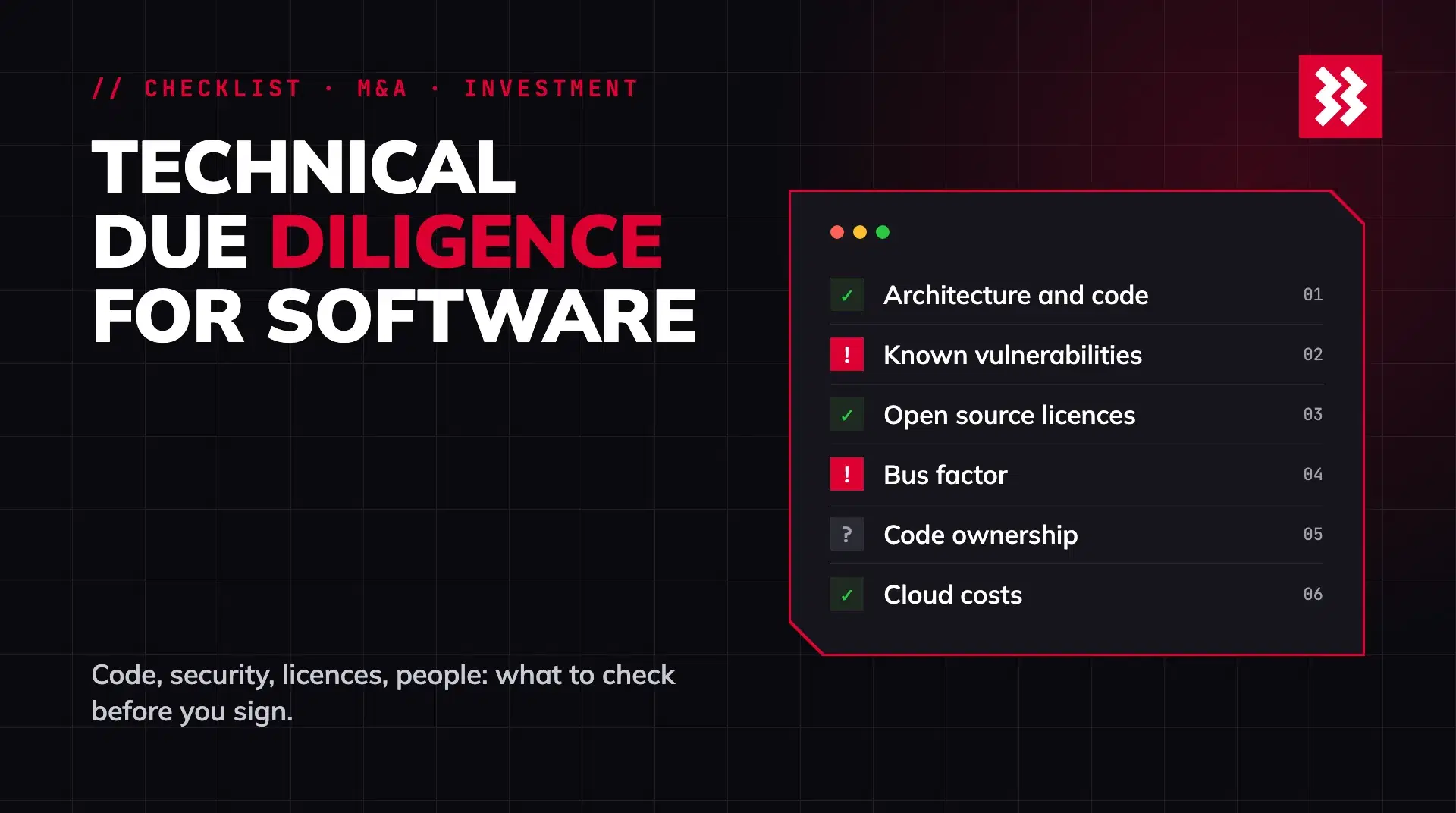
A complete technical due diligence covers eleven areas. They do not weigh the same in every deal: for a SaaS business, scalability and cloud costs matter more; for an internal business system, people and documentation matter more. Use the table as the starting point for agreeing scope.
| Area | What is checked | Evidence to request | Red flag |
|---|---|---|---|
| Code and architecture | Structure, readability, coupling between modules, consistency of technical choices | Repository access, architecture diagram | Nobody can explain how the parts connect |
| Technical debt | What slows every change today and what it costs to reduce | Technical backlog, release history, static analysis | Every small change takes weeks |
| Security and vulnerabilities | Known vulnerabilities, access and secrets management, security testing | Scan reports, penetration test results, incident log | Critical vulnerabilities known for months and never fixed |
| Open source dependencies and licences | Components in use, versions, licences and the obligations they carry | Software bill of materials (SBOM), licence policy | Copyleft licences in a distributed product with no analysis |
| Intellectual property and code ownership | Who wrote the code and on what terms, assignment of rights | Contracts with employees, freelancers and suppliers | Code written by third parties with no assignment of rights |
| Infrastructure, cloud and costs | Where the system runs, who controls the accounts, what it costs | Cloud invoices, infrastructure diagram, access list | Cloud accounts held by a supplier or an individual |
| Scalability | Whether the system can handle the volume in the plan | Load metrics, load tests, performance incidents | The plan assumes volumes never tested |
| Data and GDPR | Which personal data, where it lives, who can access it, backups | Record of processing, backup and restore procedures | Backups never restored, personal data unencrypted |
| Development, testing and release | How code gets from a developer to production | Release pipeline, test coverage, release frequency | Manual releases, no automated tests |
| People and bus factor | How many people really understand each part of the system | Technical org chart, commit history, key contracts | One person understands the core of the system |
| Documentation | Whether a new team could work on the system | Technical documentation, runbooks | Knowledge exists only in the heads of the people who wrote it |
Some areas need more explanation.
Technical debt
Technical debt is not a moral failing of the code. It is the future cost of shortcuts taken in the past. In due diligence, the absolute amount matters less than what it costs to reduce and how much it slows the buyer's plan. For how to measure it, see Technical Debt: What It Is, How to Measure It and When to Act.
Security and vulnerabilities
Unfixed vulnerabilities accumulate. Veracode's 2026 State of Software Security report, published in February 2026, defines security debt as flaws left unresolved more than a year after discovery. It found security debt in 82% of organizations, up from 74% the year before, and critical security debt in 60%. Veracode sells security tools, but the figure describes what anyone opening an existing system tends to find: known flaws, not new ones.
If a flaw leads to a breach, the cost is real. IBM's Cost of a Data Breach Report 2025 puts the global average cost of a data breach at $4.44 million.
Open source dependencies and licences
Almost all commercial software contains open source. Black Duck's 2026 OSSRA report, based on 947 commercial codebases audited between November 2024 and October 2025, found it in 98% of them. In the same sample:
- 68% of codebases contained licence conflicts;
- 78% contained high-risk vulnerabilities and 44% critical-risk vulnerabilities;
- 92% contained components more than four years out of date;
- 93% contained components with no development activity in more than two years.
Black Duck sells software composition analysis, and its sample comes from its own audit services, M&A transactions among them. The point stands: in a commercial codebase the question is not whether there is open source, but whether anyone knows the list, the licences and the state of each component.
Intellectual property and code ownership
Buying a software company means buying the right to use and sell its code, so you need to confirm the company actually owns it. Rules vary by country. In Italy, for employees, article 12-bis of the copyright law gives the employer, unless agreed otherwise, the exclusive right to exploit a program created by an employee in the course of their duties or on the employer's instructions. That rule does not cover freelancers, consultants or outside software houses: their contracts need an assignment of rights. The practical check is to match who wrote the code, which the repository history shows, against the contracts of the people who wrote it.
People and bus factor
The bus factor is the number of people who would have to leave before nobody could keep the system running. If it is one, the main risk in the deal is not in the code but in an employment contract. Commit history shows who touched what. Interviews show who actually understands it.
How it runs and how long it takes
Technical due diligence usually follows four stages.
- Scope. Agree the systems, which areas need deep coverage, access and the deal deadlines. Anything excluded goes in the report.
- Access and documents. The seller grants access to code and environments, usually read-only and under a non-disclosure agreement, and puts documents and contracts in the data room.
- Analysis and interviews. Engineers review code, infrastructure and processes and interview key people. Interviews test what the code shows; they do not replace it.
- Report and final session. The report is presented to the decision makers, who can challenge every conclusion.
The deal calendar sets most of the timeline. For reference, a WWG audit runs two to four weeks depending on the size and criticality of the system, and starts within a week of agreeing scope. The variable that stretches timelines most is not the analysis. It is how quickly access arrives.
The seller does not have to stop work. The review needs access, a few hours of interviews and one point of contact. The team keeps working.
What the report should contain
A good report is not a list of problems. It is a tool for making a decision. At a minimum it should include:
- an executive summary that can be read in a few minutes, with a clear verdict;
- every issue ordered by business impact, not by technical severity;
- an effort estimate for fixing each issue, so it can be turned into price, warranties or a post-acquisition plan;
- the evidence behind each conclusion;
- what was not checked and why, for example an area without code access;
- a recommendation: proceed, proceed with conditions, or renegotiate.
Be wary of reports that give only a score or a traffic light. A "medium risk" with no effort estimate cannot be turned into a contract clause.
Red flags that change the price or the deal
Some findings weigh more than others, because they are expensive or slow to fix.
- Code the company does not own. Parts written by freelancers or suppliers with no assignment of rights.
- Licences incompatible with the business model. Copyleft components in a product distributed to customers, with no analysis or remedy.
- Known critical vulnerabilities left unfixed, especially on internet-facing systems or systems holding personal data.
- One person who understands the system, possibly with no contract keeping them after closing.
- Cloud accounts, domains or repositories held by third parties, such as the original supplier or the founder personally.
- Infrastructure costs growing faster than revenue.
- An unsupported platform or framework that forces a migration the plan did not include. See our guide to legacy system modernization.
The deal does not necessarily fall through. More often these findings become a price adjustment, a specific warranty or indemnity, a condition to satisfy before closing or an item in the first hundred days plan. That is why the effort estimate matters as much as the diagnosis.
What drives the cost
There is no standard price, and you should be wary of anyone quoting one before seeing the scope. The factors that matter are:
- size and number of systems: a single application or a platform with several products, integrations and databases;
- depth required: a quick pass across all areas or a deep review of the critical ones;
- code access: with full access the analysis is faster and firmer; without it, more interviews are needed and the result is less certain;
- technologies: more languages and platforms call for a wider range of expertise;
- deal timeline: a tight deadline needs more people working in parallel.
How to prepare as a seller
You do not pass due diligence by hiding problems. You pass it by arriving prepared, because a problem you know about and have costed weighs less than one the buyer discovers.
- Prepare the list of open source components and their licences.
- Gather the contracts of everyone who wrote the code, employees, freelancers and suppliers, and check the assignments of rights.
- Put cloud accounts, domains and repositories in the company's name.
- Fix known critical vulnerabilities, or document why they remain open.
- Write the minimum documentation: architecture, release procedure, restore procedure.
- Consider an independent preliminary review before opening the data room. If problems surface early, you can fix or cost them yourself.
How WWG works
WWG's software audit and technical due diligence applies this checklist to a production system. It is carried out by senior engineers, a stable senior team with a named lead. One of the founders follows the engagement and leads the final session with management.
- Duration: two to four weeks depending on size and criticality, starting within a week of agreeing scope.
- What we need from you: access to code and environments, a few hours of interviews and one point of contact. Your team keeps working.
- What you get: a written report with every issue ordered by business impact, effort estimates and a recommendation, plus a working session in which we defend every conclusion.
- Terms: a standalone engagement with no obligation to continue with us. The price is set before we start, based on scope. We do not publish a price list.
One public example is the Neotecnica case: over 13,000 issues analysed, more than 19 vulnerabilities fixed and, based on the findings, a high-availability Kubernetes cluster. If the system needs securing after due diligence, the next step is software stabilization.
Sources
All pages listed were consulted on 26 November 2026.
- Black Duck, 2026 Open Source Security and Risk Analysis (OSSRA) Report, March 2026.
- Veracode, 2026 State of Software Security: Risky Debt is Rising, February 2026. Press release: Veracode, 24 February 2026.
- IBM, Cost of a Data Breach Report 2025 press release, 30 July 2025.
- Mayer Brown, Marriott International Inc fined £18.4m for personal data breach by the UK ICO under the GDPR, 16 November 2020.
- Italian Law no. 633 of 22 April 1941, article 12-bis, text on Brocardi.it (in Italian).
- WWG, Software audit and technical due diligence service page and Neotecnica case study.
FAQ
Frequently asked questions
Short answers on what a technical due diligence of software checks, how long it takes, who commissions it and what happens when it finds problems.