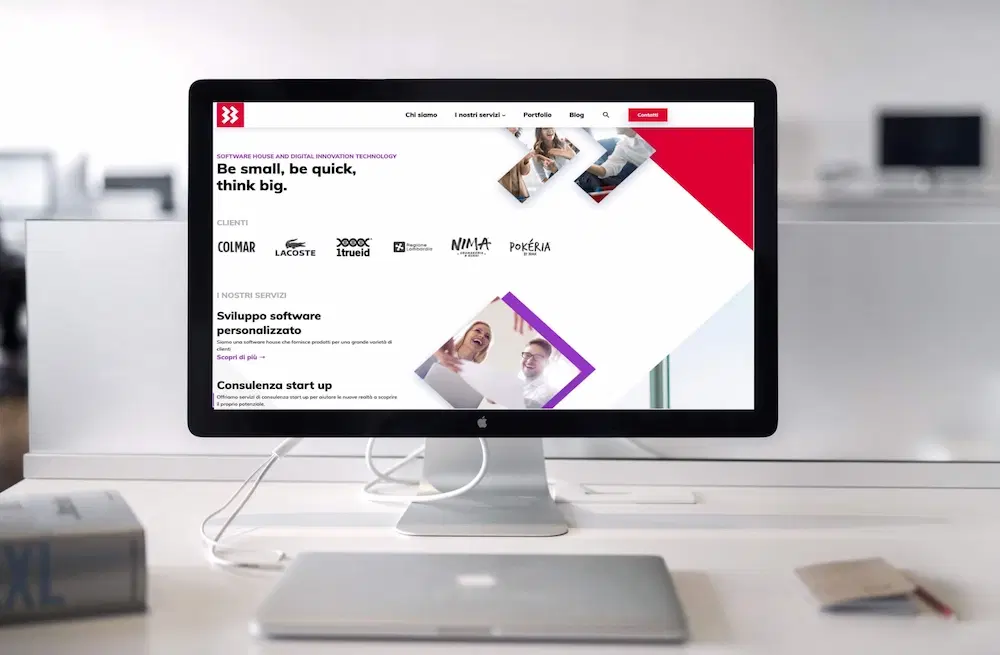
In June 2020, after twenty years of software development, WWG launched a new website: a new corporate image, pages dedicated to services and skills, a portfolio of projects and a blog designed to build a relationship of trust with people working in the industry. This article is that announcement, kept with its date and updated in 2026 with the story of the two later generations of the site: the 2025 redesign, measured in our case study on WWG's online presence, and the 2026 migration to the current platform.
TL;DR
- The 2020 website reflected the twentieth-anniversary rebrand: clean design, service pages, portfolio and a blog with technical articles and interviews.
- In 2025 the site was redesigned again with measurable goals on speed, conversions and organic traffic, with results documented in the case study.
- In 2026 it was migrated to the current platform, with an SEO programme that also included updating this and the other older articles.
- The blog remains the place where WWG explains how it works: the 2020 principle still holds.
What did the new 2020 website present?
It presented a company changing face: new offices, an expanded team open to international influences, a renewed marketing strategy and a fresh, modern website mirroring the internal improvements under way. A clean design guided visitors to discover the corporate culture, skills and services offered, with a complete overview of previous experience in the portfolio.
The blog was built with the idea of creating a relationship of trust with users: technical articles and news, but not only, written to solve the small and big problems of people working in software development, with content, ideas, interviews and advice at the centre. It was meant to become a virtual meeting place between WWG's clients and those who could become clients, between those who already knew our flexible innovation model and those who, reading about us, might discover they shared our values. The launch accompanied the company's twentieth anniversary.
How has the website changed from 2020 to today?
Two redesigns. In 2025 the site was redesigned with measurable goals: a modern interface, shorter load times, clear calls to action, rewritten service pages and a content and SEO strategy; the results on speed, organic traffic and leads are documented in our case study on the transformation of WWG's online presence. In 2026 the site was migrated to the current platform, keeping page addresses and adding an SEO programme that includes updating the older articles, this one included.
| Year | Site version | What changed |
|---|---|---|
| 2020 | Rebrand and new website | New identity, service pages, portfolio, blog |
| 2025 | Redesign | Speed, conversions, rewritten service pages, SEO and content strategy |
| 2026 | Migration to the current platform | Same addresses, new performance, update of historical articles with a revision date |
The 2020 principle has not changed: the blog is where we explain how we work, from agile methodology to the cost of an app, and the website is the business card that must reflect what the company is today. Anyone who wants to know what WWG is like in 2026 will find the answer on the about page.
Would you like a website that reflects your company today? Talk to a WWG engineer at business@wwg.it.
FAQ
Frequently Asked Questions
In June 2020, for the company's twentieth anniversary, with a complete rebrand. The site was then redesigned in 2025 and migrated to the current platform in 2026; this article is the 2020 announcement, kept with its date and updated with the later milestones.
Interface and speed, calls to action, rewritten service pages and a content and SEO strategy with measurable goals on organic traffic, conversions and leads. The results are documented in the case study on the transformation of WWG's online presence, published in 2025.
Because many still receive visits and answer questions that are still current, and because the company's history has documentary value. Updated articles keep their original publication date and show the revision date; where the content was tied to a specific moment, it is kept as a record of the time with a note.