How much it costs to build an app in Italy in 2026 depends on what the app has to do: features, platforms, integrations and the level of security. The most reliable public data comes from procurement: in the contracts Italian public bodies awarded to have an app developed in 2024 and 2025, the median value is 25,000 euros and half of the contracts fall between roughly 14,600 and 55,600 euros, according to ANAC open data.
This guide brings together independent sources, each with its date: public contracts recorded by ANAC, Italy's national anti-corruption authority; prices on the Italian marketplace ProntoPro; and Clutch's international pricing guide, based on verified reviews. They are market references to help you get your bearings, not the price of your app: that only comes from a quote for your project.
TL;DR / In brief
- Across 163 public contracts for app development awarded in Italy in 2024-2025, the median value is 25,000 euros and the middle half ranges from 14,625 to 55,586 euros (ANAC open data, WWG analysis).
- On the ProntoPro marketplace, app development prices range from 990 to 9,250 euros: small, tightly scoped jobs, almost always by individual freelancers.
- Globally, most app projects reviewed on Clutch cost between 10,000 and 49,999 dollars; the average project costs about 90,780 dollars and takes about 11 months.
- Cost grows with features, integrations, design, security and the number of platforms; after launch come maintenance, hosting and app store costs.
- A serious quote separates analysis, design, development, testing, release and maintenance, and states what is excluded.
How much does it cost to build an app in 2026?
The independent sources available give three different measures of the same market. None of them is the price of a specific app, but together they show where a project sits. Figures are given in the source's currency, without conversion.
| Source | What it measures | Market reference |
|---|---|---|
| ANAC, public contracts 2024-2025 (WWG analysis) | 163 contracts awarded by Italian public bodies for app development | Median 25,000 euros; half of the contracts between 14,625 and 55,586 euros; 68% under 40,000 euros |
| ProntoPro (consulted on 5 October 2026) | Prices on the Italian marketplace for app development | From 990 to 9,250 euros, depending on the details of the job |
| Clutch, app pricing guide (September 2026) | App projects worldwide, from verified client reviews | Most between 10,000 and 49,999 dollars; average about 90,780 dollars; typical duration about 11 months |
| Clutch, hourly rates (September 2026) | Typical rate of the app development companies reviewed | 25-49 dollars an hour globally; 25-49 in Spain, 50-99 in Poland |
Clutch uses four budget bands: under 10,000 dollars, 10,000-49,999, 50,000-199,999 and over 200,000. In general, a first version with few features (an MVP) sits in the lower bands, while an app with many user roles, payments, integrations with business systems and real-time features moves into the upper ones. Some Italian software houses that publish a price list quote between 20,000 and 40,000 euros for an MVP (Mabiloft, 2025).
How much does the Italian public sector spend on an app?
Public procurement is the only Italian source where app prices are published contract by contract. We analysed ANAC's open datasets for 2024 and 2025: since 2024, contracts under 40,000 euros also go through the national platform and appear in the same data, so small and large contracts are counted the same way.
Out of 3,216 records whose contract description mentions an app, we kept the 163 contracts for actual development. We excluded licences, subscriptions, maintenance and enhancements of existing apps, integrations with the government's IO app, framework agreements, and amounts under 1,000 or over 1 million euros. The result:
- Median value: 25,000 euros.
- Middle half of contracts: between 14,625 and 55,586 euros.
- Under 40,000 euros: 68% of contracts.
- Direct awards: 92%.
Some examples from the ANAC data, each with the CIG code that lets you verify it:
| Public body | Year | Subject (abridged) | Amount | CIG |
|---|---|---|---|---|
| Fondazione Bruno Kessler | 2025 | Mobile app for expense reports and business travel | 16,000 euros | B8D9B16951 |
| Casoria Ambiente S.p.A. | 2025 | Mobile app for bulky-waste collection and reports | 23,000 euros | B785AB1B15 |
| Università degli Studi di Milano-Bicocca | 2024 | Hybrid iOS and Android mobile app for caregivers | 25,000 euros | B29C25C855 |
| Comune di La Spezia | 2024 | App for Android and Apple iOS | 60,600 euros | B4CF1EDFBC |
| Trenord S.r.l. | 2025 | Design of a new Trenord app | 133,000 euros | B62A18E91D |
A public contract is not a private project. The scope is fixed before the award, almost all contracts are direct awards, and the amount may include other work, such as a website or content. Read it as what a public body actually paid, not as a price list.
Why do quotes for the same app vary so much?
Quotes differ because they rarely describe the same work. The features included, the level of design, the amount of testing, who publishes the app on the stores, who maintains it after launch and who is accountable if something goes wrong all change. So does who builds it.
- Freelancers and small studios. ProntoPro's 990-9,250 euros suit small, well-defined jobs, not a product with a backend, integrations and maintenance.
- Development companies. Projects reviewed on Clutch usually include analysis, design, frontend and backend development, testing and release, with a team accountable for the result.
- Hourly rates. Clutch gives 25-49 dollars an hour as the typical rate, with large differences between countries: 50-99 dollars in Poland and Canada, 100-149 in Australia.
A lower hourly rate does not automatically mean a cheaper app: what matters is how many hours are needed, how many are lost to rework and who pays for mistakes. That is why a quote should be read line by line, not just on the total.
Which factors affect the cost of an app the most?
The biggest factors are the number and complexity of features, the platforms to support, integrations with other systems, the level of design and the security requirements. An integration with the company's ERP or a real-time feature can cost more than many simple screens put together.
- Features: each feature needs design, development and testing; payments, chat, geolocation and AI features are the most demanding.
- Platforms: iOS, Android, web, or all three; a cross-platform app with a single codebase usually costs less than two native apps.
- Integrations: connecting the app to ERP, CRM, warehouse, payment systems or third-party APIs requires extra analysis and testing.
- Design: a custom interface with animations and micro-interactions costs more than one built from standard components.
- Security and compliance: personal data, payments or regulated industries add requirements, checks and documentation.
- Backend and infrastructure: the expected users, data and traffic determine how robust the server side needs to be.
What should a serious app development quote include?
A serious quote breaks the work into phases, sets out the activities and responsibilities for each, says what is included and what is not, and separates the development cost from the cost of running the app after launch. A single price with no breakdown is hard to compare and almost always hides assumptions that will surface later as extras.
Line items may have different names from one vendor to another, but these should always be there:
- Analysis and requirements: goals, users, priority features, integrations and risks, with a requirements document as the output.
- UX and UI design: flows, wireframes and the visual interface, with the number of revision rounds included.
- Development: frontend for each platform, backend, APIs and integrations, broken down by feature or by iteration.
- Testing and quality: functional, automated, security and real-device testing, with acceptance criteria.
- Release: app store publishing, setup of environments and monitoring.
- Maintenance and support: updates, fixes and support after launch, as a retainer or pay-as-you-go.
- Exclusions and assumptions: what is not covered, what the client must provide and what would change the price.
Also ask how changes during the project will be handled. A vendor that works in iterations should explain how features can be swapped within the same budget, instead of turning every change into an extra. If a quote puts almost everything into development and almost nothing into analysis and testing, it is not cheaper: it pushes those costs later, when fixing a mistake costs more.
How much does an MVP cost compared with a full app?
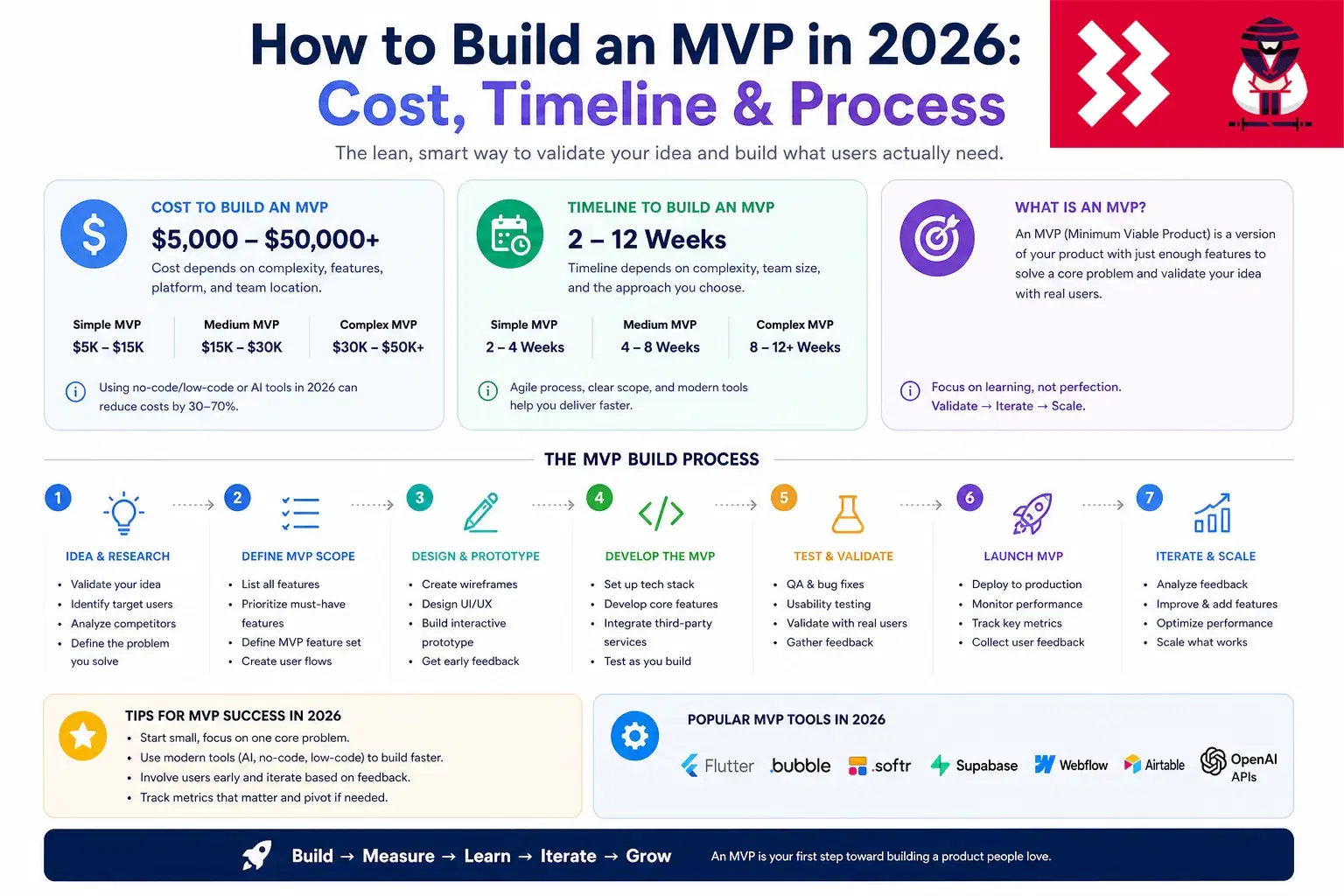
An MVP costs much less than a full app because it contains only the features needed to test the idea with real users. It is the safest way to keep the initial investment in check: you spend less to learn whether the product works, then invest in the features users actually use.
For the cost, timeline and process of a first version, read our 2026 guide to building an MVP. If you need a team to get started, WWG's mobile app MVP service focuses on the essential features and on feedback from the first users, while mobile app development covers the versions that follow.
Native or cross-platform: how does the cost change?
A cross-platform app, written with a single codebase for iOS and Android using frameworks such as Flutter or React Native, usually costs less than two separate native apps, because much of the work is done only once. A native app remains the right choice when you need high performance or features closely tied to the device. According to Clutch, the typical hourly rate is the same, 25-49 dollars, for Android, iOS and cross-platform apps: the cost difference lies in the hours, not the rate.
Our guide to cross-platform mobile app development in 2026 compares the main frameworks and explains when each one makes sense.
How much does it cost to maintain an app after launch?
After launch there are recurring costs to budget for from the start: updates for new iOS and Android versions, fixes, security patches and small enhancements. How much they weigh depends on how integrated the app is with other systems and how often it changes; it is worth having them quoted separately, as a retainer or a bank of hours.
On top of that come costs you can verify at the source:
- Developer accounts: the Apple Developer Program costs 99 dollars a year (or the equivalent in local currency), while a Google Play developer account has a one-time registration fee of 25 dollars.
- App store commissions on paid apps and in-app purchases: the App Store Small Business Program offers a reduced 15% commission to developers earning less than 1 million dollars a year.
- Hosting and cloud services, which grow with users, data and traffic.
- User support and marketing, which no development quote covers but which decide whether the app gets used.
How long does it take to develop an app?
Clutch gives a typical duration of about 11 months for an app development project, at an average cost of about 8,190 dollars a month. An MVP with few features needs much less; an app with many integrations or real-time features needs more.
Timelines also depend on the client: clear requirements, a contact person who decides quickly and content that is ready shorten a project more than any technical choice.
Can you build an app yourself?
Yes, for a prototype or a simple internal tool: no-code platforms let you build screens, forms and basic flows without programming. The limit comes when the app has to integrate with company systems, handle personal data or payments, support many users and be published on the stores as a customer-facing product: at that point you need a development team.
What questions should you answer before asking for a quote?
Before asking for a quote, it pays to clarify who will use the app, what it must do for each type of user, which systems it must talk to and how success will be measured. Involve whoever handles IT in your company and share the answers with a colleague: you will quickly see which decisions are still missing.
- Who are the users, and will they all use the app in the same way, or do you need different roles?
- Which features are needed in the first version, and which can wait?
- Which systems must it talk to: ERP, CRM, warehouse, payments?
- What personal data does the app handle, and with what security obligations?
- Do you need notifications, and what information should be sent to users, and when?
- Native or cross-platform, one platform or both?
- Who will handle maintenance and updates after launch?
- How will you measure the app's success, and with which KPIs?
The answers to these questions are the basis of any serious quote, and they let you compare different offers on the same scope.
Already have the answers? Use them for an estimate with QuickQuote, or write to us at info@wwg.it and we will tell you where it makes sense to start.
Sources
- ANAC, Banca Dati Nazionale dei Contratti Pubblici (Italy's national public contracts database), open datasets CIG 2024, CIG 2025 and Aggiudicazioni (CC BY 4.0 licence; downloaded on 5 October 2026; WWG analysis: mobile app development contracts, CPV 72 and 48, award amount between 1,000 euros and 1 million euros, excluding licences, subscriptions, maintenance, integrations with the IO app and framework agreements) — https://web.archive.org/web/20261005101038/https://dati.anticorruzione.it/opendata/dataset/cig-2025 · https://web.archive.org/web/20261005101101/https://dati.anticorruzione.it/opendata/dataset/aggiudicazioni
- ProntoPro, Sviluppo App (prices on the platform, consulted and archived on 5 October 2026) — https://web.archive.org/web/20261005091514/https://prontopro.it/sviluppo-app
- Clutch, App Development Pricing Guide (updated on 21 September 2026; archived on 26 September 2026) — https://web.archive.org/web/20260926122550/https://clutch.co/directory/mobile-application-developers/pricing
- Mabiloft, Quanto costa sviluppare un'app nel 2025? (published on 2 September 2025; archived on 5 October 2026) — https://web.archive.org/web/20261005091425/https://mabiloft.com/it/blog/insights/quanto-costa-sviluppare-unapp-nel-2025
- Apple, Apple Developer Program, Membership Details (archived on 5 October 2026) — https://web.archive.org/web/20261005091531/https://developer.apple.com/programs/whats-included/
- Google, Play Console Help: Get started with Play Console (consulted on 5 October 2026) — https://support.google.com/googleplay/android-developer/answer/6112435?hl=en
- Apple, App Store Small Business Program — https://developer.apple.com/app-store/small-business-program/
FAQ
Frequently Asked Questions
The questions people most often ask about cost, timelines and maintenance before having an app built.