DevOps culture is the set of shared habits that lets development and operations work as one team: open communication, shared responsibility for software in production, and continuous integration of everyone's work. Tools and pipelines put it into practice, but without the culture they only automate the old silos.
DevOps (development and operations) is a set of practices inspired by agile and lean thinking, based on active collaboration and communication between everyone involved in the business, so that software can be released continuously. This short piece covers the cultural side: why it matters, the principles the community agrees on and the benefits you can expect. For the technical side, read our guide to how a CI/CD pipeline works.
TL;DR / Key Takeaways
- DevOps is a culture before it is a toolchain: development and operations share goals, information and responsibility.
- It was first adopted by large web companies such as Netflix and Google and is now used by many traditional companies.
- The community agrees on four principles: continuous integration and testing, continuous delivery and deployment, continuous operations and continuous assessment.
- The benefits are a more fluid workflow, smaller and more controllable releases, a faster time to market, less waste and lower long-term costs.
Why does DevOps start with communication and collaboration?
DevOps starts with communication because most delivery problems are hand-off problems: developers finish work that operations cannot run, and operations learn about changes too late. When both sides share goals, information and responsibility for production, feedback arrives faster and products can be changed in a more targeted and effective way.
This approach creates an effective and fast working environment. Instead of throwing releases over a wall, the team that writes a service also cares about how it is deployed, monitored and fixed. Operations, in turn, get involved early and shape how software is built so that it is easier to run.
At the beginning, DevOps was adopted mainly by large companies of the web world, such as Netflix, Google and other giants of the industry. Over time, many traditional companies have introduced its principles to adapt to the market and keep up with the times.
What are the core principles of DevOps?
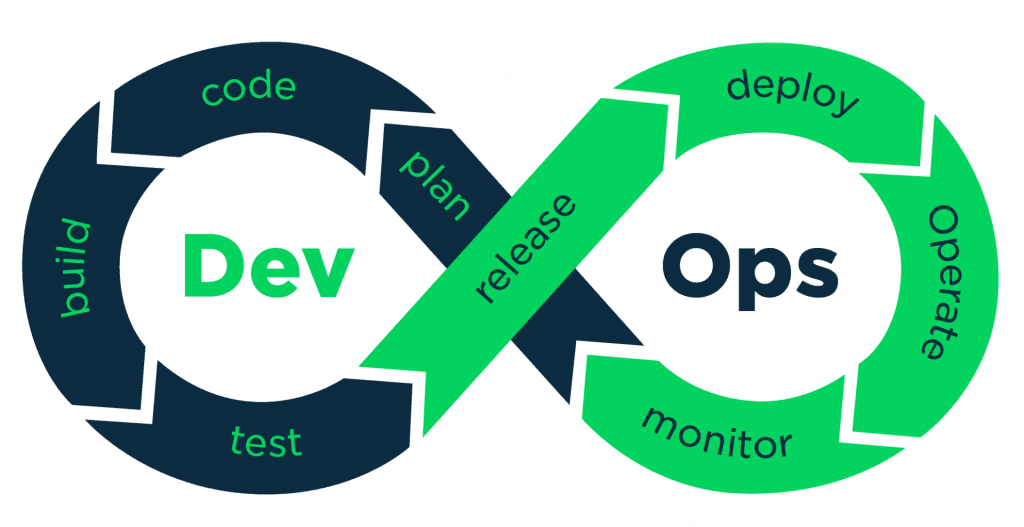
DevOps is a varied and multifaceted field, but the community recognises some basic principles. Developers integrate and test code continuously, build software so it can be released at any time, change systems without interrupting users, and keep improving the product based on feedback. Together they form the loop that DevOps teams repeat every day.
- Continuous integration and testing: developers integrate code several times a day, and an automated test system checks every change to catch problems early. Each new feature is then known not to conflict with the existing environment or break the application.
- Continuous delivery and deployment: software is built so that it can potentially be released at any time, which is possible by standardising the configuration of the infrastructure.
- Continuous operations: changes are managed so that end users can keep using the software while it is updated.
- Continuous assessment: the team works on the product based on feedback, especially feedback loops, which record the user experience throughout the product's life cycle, and planning prioritisation, which assigns a priority to each piece of feedback as it arrives.
What does integration mean in a DevOps culture?
Integration in DevOps means two things. Technically, everyone's code is merged and tested together many times a day instead of at the end of a project. Organisationally, the skills of development, testing, security and operations are brought into the same team and the same workflow, so nobody works on a separate island.
Both kinds of integration reduce surprises. Merging small changes often keeps conflicts small, and having operations and security in the room early means their requirements are built in rather than added at the end.
It also changes how problems are handled. When something fails in production, the question is not whose fault it is but what the team can change in the system or the process, which keeps people willing to report problems early.
What are the benefits of a DevOps culture?
A DevOps culture makes the workflow more flexible and fluid. Releases become smaller and more frequent, and therefore easier to control; time to market improves; and teams waste less time and money over the long term, because problems are found early, when they are still cheap to fix.
Those benefits depend on the practices behind them, above all automated testing and deployment. The five DORA metrics, change lead time, deployment frequency, failed deployment recovery time, change fail rate and deployment rework rate, are the standard way to check whether the culture is actually changing delivery. Our CI/CD pipeline guide explains each of them.
Some companies introduce these practices with outside help. WWG's DevOps consulting services focus on making delivery repeatable so that releases stop being events, and dedicated DevOps engineers can join your team when you need the capacity in-house.
To discuss how to bring development and operations closer in your company, write to us at business@wwg.it.
Sources
- Amazon Web Services, What is DevOps? — https://aws.amazon.com/devops/what-is-devops/
- DORA, DORA's software delivery performance metrics — https://dora.dev/guides/dora-metrics/
FAQ
Frequently Asked Questions
Start with one shared goal and one shared pipeline. Put developers and operations people on the same team for one service, agree on how changes reach production, automate the first manual step that causes problems, and review every incident together without blame. Culture changes through repeated shared work, not through a reorganisation announced from above.
Yes. A small company often adopts DevOps more easily than a large one, because fewer teams and hand-offs are involved. Automating tests and deployments, keeping infrastructure in version control and sharing responsibility for production bring the same benefits at small scale, and they avoid the manual release steps that slow a small team down most.
Agile focuses on how teams plan and build software in short iterations with regular feedback from users. Agile is the starting point; DevOps extends the same ideas to releasing and running that software, so that what the team builds reaches production quickly and reliably. Together, agile decides what to build next and DevOps gets it to users safely.