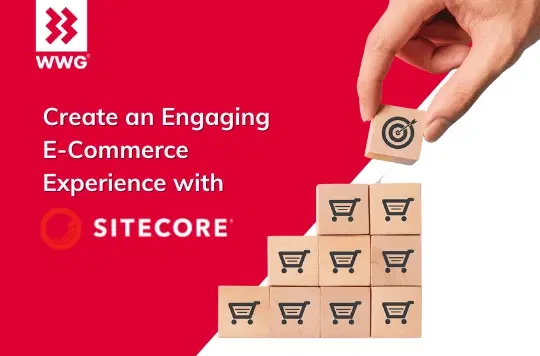
Sitecore is a digital experience platform that brings together content management, personalisation and commerce, and its use in e-commerce rests on one idea: connecting content and selling in the same customer journey, with behavioural data at the centre. This article, published in 2022 about Sitecore Experience Commerce and updated in 2026, explains what Sitecore offers e-commerce, the strengths that made organisations choose it, how the offer has changed with the composable approach, and when it is the right choice.
TL;DR
- Sitecore's value in e-commerce is connecting content and commerce: no siloed data between departments, one customer profile, personalisation across the whole journey.
- The ten strengths listed in 2022 still hold as evaluation criteria: user journeys, personalisation, marketing automation, rules, intelligent back end, testing, multilingual content, real-time orders, data-driven marketing, cloud.
- Sitecore's offer has moved to a composable architecture, with content and commerce as separate, integrable services; check the support timeline before building on Experience Commerce.
- Sitecore is the right choice for organisations with many markets, rich content and a team that will really use personalisation; for a simple catalogue it is oversized.
- Payment, ERP integration and product data quality decide the outcome more than the platform does.
Why do organisations choose Sitecore for e-commerce?
Organisations choose Sitecore for e-commerce because it connects two crucial elements of the shopping journey, content and the selling experience, removing siloed data between departments and creating effective communication between marketing, sales and IT. The customer sees one experience; the company works on one profile.
Online shopping is one of the most prominent uses of the internet, and its growth has driven demand for tools to build and support digital commerce. Sitecore is one of the established digital experience platforms, chosen by brands that want to manage content, personalisation and selling from a single set of tools.
The platform collects real-time data from various channels, integrates with third-party solutions and analytics, generates relevant content for users with machine learning, and lets marketers create different scenarios without additional development.
What are Sitecore's strengths in e-commerce?
The strengths are ten: enhanced user journeys, a personalised purchasing process, marketing automation, rule-based configurations, an intelligent back-end sales cycle, content optimisation and testing, multilingual capabilities, real-time order placement and delivery, data-driven marketing and cloud connectivity. They were the arguments of 2022 and remain the criteria for evaluating any commerce platform.
| Strength | What it means in practice |
|---|---|
| 1. Enhanced user journeys | Every step a visitor takes to convert is defined and measured, from discovery to transaction |
| 2. Personalised purchasing | The platform knows who the user is, what they bought, whether they abandoned a cart, and adapts products, upsells and reorders |
| 3. Marketing automation | Complete flows driven by behavioural data: e-mails on abandoned carts, campaigns on relevant products |
| 4. Rule-based configurations | Experience processes automated with visual rules, without handling each event separately |
| 5. Intelligent back end | Rules for out-of-stock items, updates, multiple catalogues, physical and digital orders, secure payments, localisation |
| 6. Optimisation and testing | A/B and multivariate tests on fields, content, pages and whole experiences, with tracked KPIs |
| 7. Multilingual | Content for international sites managed from one platform |
| 8. Real-time orders | Inventory synchronised between stores, website and warehouse through ERP integration |
| 9. Data-driven marketing | Profiles enriched from every source and channel, with machine learning generating recommendations |
| 10. Cloud | Cloud deployment with managed scalability and updates |
The first and ninth points are what really distinguish an experience platform from a shopping cart: personalisation only works when behavioural data is collected at every touchpoint and used to decide what to show to whom.
What has changed in Sitecore's offer since 2022?
Sitecore's offer has moved from an integrated suite to a composable architecture in which content management and commerce are separate, API-based services that combine with other tools. Sitecore now positions cloud content management and OrderCloud, its headless commerce platform; Sitecore Experience Commerce, the subject of the original article, belongs to the previous generation. (doc.sitecore.com)
For companies with an existing Experience Commerce project the question is when and how to migrate; for those starting today the choice is between Sitecore's composable stack and the market's other headless options. In both cases the support timeline of the versions should be checked directly with Sitecore before deciding, because it changes investment priorities.
The ten strengths do not disappear with the change of architecture: in the composable stack they are spread across separate services (content, personalisation, commerce, search) that have to be integrated, and integration becomes the main part of the project.
When is Sitecore the right choice for an e-commerce, and when not?
Sitecore is the right choice for organisations with many markets and languages, rich content, a complex catalogue and a marketing team that will really use personalisation and testing. It is not the right choice for a simple catalogue, a small team or a budget that does not cover integration and ongoing operation: in those cases a lighter commerce platform delivers results sooner.
| Situation | Indication |
|---|---|
| Several markets and languages, rich content | Sitecore or an equivalent composable stack |
| Complex B2B catalogue with price lists and roles | Headless commerce platform with solid ERP integration |
| Marketing team working on segments and tests | Personalisation pays back the investment |
| Simple catalogue, small team | Lighter platform, less integration |
| Budget for the project but not for operation | Review the scope before choosing a platform |
Whatever the platform, three elements decide the outcome: structured product data, as we explain in our fashion online catalogue; ERP integration for orders and availability; and payment compliant with strong customer authentication, covered in our article on PSD2 and 3D Secure 2. WWG delivers e-commerce projects on Sitecore and other platforms as part of its web application development services.
Evaluating a platform for your e-commerce? Talk to a WWG engineer at business@wwg.it.
Sources
FAQ
Frequently Asked Questions
Sitecore is a digital experience platform that brings together content management, personalisation and commerce. In e-commerce it connects content and selling in the same customer journey: one behavioural profile drives what to show, which products to suggest and which campaigns to run, across every channel and language.
Sitecore Experience Commerce belongs to the previous generation of Sitecore's offer, which has moved to a composable architecture with OrderCloud as its headless commerce platform. Before building or extending a project on Experience Commerce, check the support timeline of the versions with Sitecore, because it determines investment and migration priorities.
Organisations with several markets and languages, rich content, a complex catalogue and a marketing team that will really use personalisation and testing. For a simple catalogue or a small team it is oversized: integration and ongoing operation cost more than the benefit, and a lighter platform brings results sooner.
Structured product data, ERP integration for real-time orders and availability, and payment compliant with strong customer authentication. These make personalisation, automation and logistics work on any platform, and they are the items most often underestimated in the initial estimate.