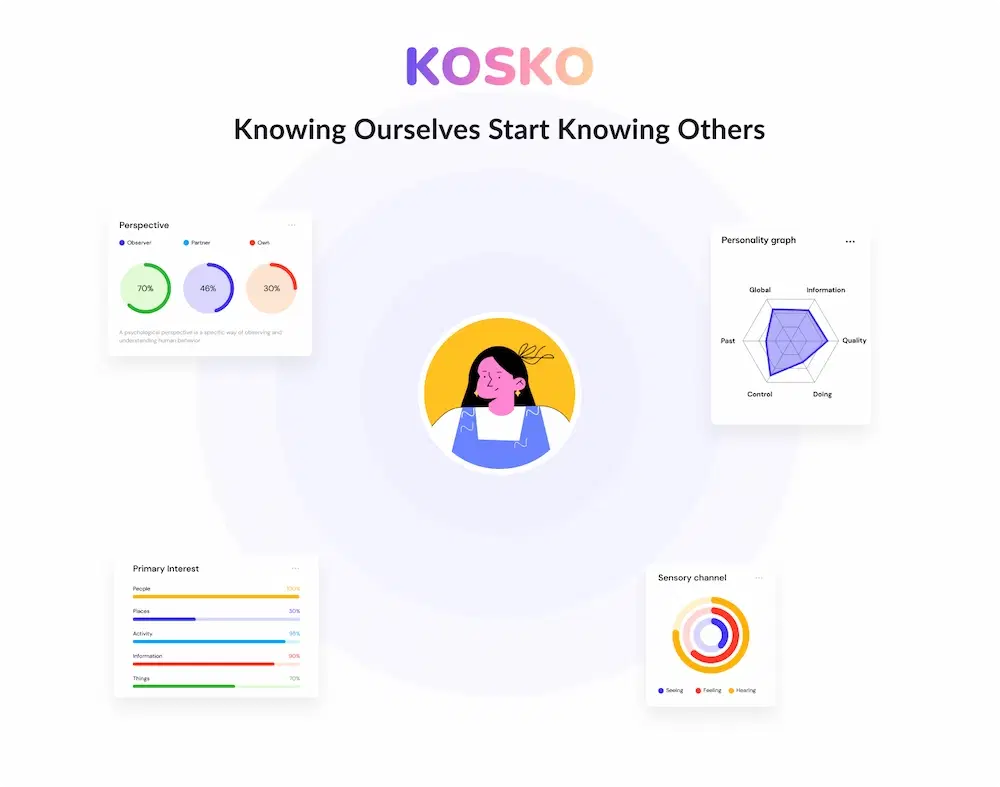
A team personality assessment is a structured way of measuring how the people in a team think, communicate, decide and react under pressure, and of using that picture to compose teams, resolve friction and help managers lead each person in the way that works for them. Kosko is a platform that does this with questionnaires and natural-language analysis, built with the collaboration of Italian universities and developed by WWG. This article, published in 2022 and updated in 2026, explains why personality assessment matters for team performance, what Kosko measures, how managers use the results and what WWG built to make it work; the project story is in the case study.
TL;DR
- Most employees are not engaged with their work: Gallup's State of the Global Workplace has tracked low engagement for years, and disengagement shows up as turnover, errors and friction.
- Personality assessment gives teams a shared vocabulary for differences that otherwise become conflict: how people prefer to receive information, make decisions and handle stress.
- Kosko measures personality factors from a short questionnaire and from the language people use, and turns them into a report for the individual and a map for the manager.
- Managers use it to compose teams, assign roles, prepare one-to-ones and spot friction early; employees use it to understand themselves and their colleagues.
- WWG built the platform end to end, from the assessment engine to the web application; the case study describes the architecture and the results.
Why does team personality matter for performance?
It matters because most of what goes wrong in teams is not a lack of skill but a mismatch in how people work: one person needs context before deciding, another decides and adjusts; one reads silence as consent, another as disagreement. Gallup's State of the Global Workplace has shown for years that only a minority of employees worldwide are engaged with their role, and disengagement costs companies in turnover, errors and friction. (gallup.com)
Building high-performing teams is hard for managers and HR professionals: the team has to be aligned on strategy, have the skills to execute and keep growing with the business. Team building is not something you do once a year; it is a continuous process, and it needs information. A personality assessment does not replace judgement, but it gives a team a shared vocabulary for differences that would otherwise surface as conflict, and gives managers a way to adapt how they lead each person.
What does Kosko measure and how?
Kosko measures the main personality factors of a person from a short questionnaire and from the language they use, applying machine learning and natural-language processing to produce a profile that is more precise than the broad type labels of traditional tests. The model was developed in collaboration with Italian universities and professors, and the output is a report the person can read and act on.
| What is measured | Why it matters in a team |
|---|---|
| How a person prefers to receive information | Decides whether a brief should be a document, a call or a demo |
| How they make decisions | Explains who needs data first and who decides and adjusts |
| How they handle pressure and conflict | Helps the manager anticipate friction and prepare one-to-ones |
| Strengths and development areas | Guides role assignment and growth plans |
| Compatibility with colleagues | Supports team composition and pairing |
Kosko is simple to use: an e-mail address, a short questionnaire, and a comprehensive report with the personality profile, strengths, weaknesses and suggestions. Managers see the team map rather than only individual results, and can compare profiles when composing a team or planning a project.
How do managers and employees use the results?
Employees use the report to understand how they work and how to work better with others; managers use the team map to compose teams, assign roles, prepare conversations and notice friction before it becomes a problem. The value is in the conversation the report starts, not in the label.
The major benefits, as we described them in 2022, still hold: Kosko helps employees understand themselves and each other, helps teams build relationships and trust, helps teams understand their unique challenges and helps managers build better teams. In practice we see three recurring uses: onboarding, where a new hire's profile helps the team adapt from week one; project staffing, where complementary profiles are chosen on purpose; and retrospectives, where recurring friction is read through the profiles rather than as personal fault. The practices this supports, from transparent communication to recognition, are the ones we describe in our article on a positive work environment.
What did WWG build for Kosko?
WWG designed and built the platform end to end: the assessment engine that scores the questionnaire and the language analysis, the data model for individual and team profiles, the web application for employees and managers, and the reporting. The architecture, the choices on privacy for sensitive personal data and the results are described in the Kosko case study.
Two design decisions mattered most. The first was to keep the questionnaire short enough to be completed in minutes, because completion rate decides whether a team map is complete. The second was to treat personality data as sensitive: profiles are visible to the person and to the managers entitled to see them, with consent recorded, and the platform was built to comply with European data-protection rules. The project is an example of the kind of web application development WWG does for product companies: a model from research, turned into a product people actually use.
Want to build a product from a research model? Talk to a WWG engineer at business@wwg.it.
Sources
FAQ
Frequently Asked Questions
A structured way of measuring how the people in a team think, communicate, decide and handle pressure, usually with a questionnaire and sometimes with analysis of the language they use, and of using the results to compose teams, assign roles and help managers adapt how they lead each person. It gives teams a shared vocabulary for differences.
A platform for companies, small businesses and individuals that measures personality factors with a short questionnaire and natural-language processing, developed with the collaboration of Italian universities and built by WWG. It produces a report for the individual and a team map for managers, to build better teams and improve relationships at work.
Many tests give a broad type label; Kosko scores the main personality factors from both a questionnaire and the language a person uses, and presents them as a profile with strengths, development areas and compatibility with colleagues. It is designed for teams rather than individuals, so managers see the team map and not only separate results.
It is sensitive personal data and must be treated as such: visible to the person and to the managers entitled to see it, with consent recorded, stored and processed in compliance with European data-protection rules. WWG built Kosko with these constraints from the start; the case study describes the choices made.