OKRs (Objectives and Key Results) are a goal-setting framework in which a team states one ambitious objective and measures progress with a few numeric key results. They turn priorities into something a whole team can see, score and review every quarter.
TL;DR
- An OKR pairs one qualitative Objective with about three measurable Key Results, reviewed every quarter.
- OKRs are collective, not individual: teams write them together and keep them visible to everyone.
- They are not a task list, not a KPI dashboard and not tied to the size of a project.
- KPIs watch the health of what already runs; OKRs push a team towards a change it wants to make.
- A score of about 0.7 is the target for stretch goals, because hitting 1.0 every time means the goals were too easy.
What are OKRs?
OKRs are a goal-setting method that pairs a qualitative Objective, which says where you want to go, with a few Key Results, which are numbers that show whether you are getting there. Teams write them for a fixed period, usually a quarter, and score them at the end.
The method is generally credited to Andrew Grove, who used it at Intel in the 1970s and described it in his 1983 book High Output Management. John Doerr, who learned it at Intel, introduced OKRs to Google in the early 2000s, and Google still sets annual and quarterly OKRs and grades them each quarter. Google's own guidance suggests three to five objectives with about three key results each.
A short worked example shows the shape for a software team:
- Objective: Make releases so routine that nobody dreads them.
- Key Result 1: Move from one release a month to one release a week.
- Key Result 2: Cut the share of releases that need a hotfix from 20% to 5%.
- Key Result 3: Reduce the time from merged code to production from five days to one.
The numbers are illustrative, not WWG data. What matters is that the Objective is a direction people care about, while every Key Result can be scored with a number at the end of the quarter.
What are OKRs not?
OKRs are not an individual to-do list, a mental exercise, a single metric, a tool that only fits big projects or a set of targets carved in stone. Most teams that struggle with OKRs have fallen into one of these five traps. Each one is worth naming, because each has a positive counterpart.
OKRs are not individual, they are collective. Setting the right company OKRs is always multi-handed work. Every professional has personal OKRs, written independently after talking with the rest of the team, and then come the team OKRs. OKRs keep departments aligned by picking a few paths, usually three to five, towards one goal. At WWG the OKR management software lets every employee see and update personal OKRs and check the status of other teams.
OKR's Course at the end of March
OKRs are not a mental construct, they are an engine. Written well, measured properly and reviewed at a good cadence, an OKR defines priorities, concentrates effort and keeps a team focused. Large companies such as Google, LinkedIn, Amazon, Facebook and Spotify are known for using them. OKRs also train a team to check quickly whether its goals still reflect the company's real priorities. That is why at WWG we talk about OKRs every Monday.
OKRs are not just a metric, they are a path. KPIs measure the impact of a solution, but on their own they do not turn into a strategy. Goals that arrive from above without an agile culture leave everyone free to choose how to reach them, which adds entropy, complexity and often confusion. At WWG the Key Results stay linked to the Objectives inside the OKR software. The boards could tie Key Results to stories and epics in each sprint, but we prefer to keep the OKR check as a separate activity at the end of each quarter.
OKRs are not a function of project size, but they can manage complexity. They work for the construction of Noah's Ark, for non-profit projects or for OKRs written in a few minutes. An OKR is not a shot in the dark but an arrow fired at a target. It creates responsibility, appeals to ownership and improves collaboration, and people who use OKRs learn to see failure as a chance to improve rather than something to hide.
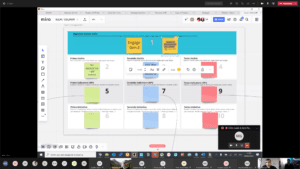
Writing of the OKR of the teams involved in the Open Innovation project IULM/COLMAR/WWG
OKRs are not carved in stone, but they are not a wish list either. An OKR system should not need abrupt strategy changes except in truly extraordinary cases. Used as a calibration tool, OKRs let everyone adapt to new information, drop goals that will clearly not be reached and add attention to "edge" goals that deserve more resources. Marco Imperato of Product Heroes notes that how often OKRs change depends on where you sit in the hierarchy: the closer to the base, the more change concerns how to reach the goals set from above rather than the goals themselves.
How are OKRs different from KPIs?
OKRs describe a change you want to make, while KPIs describe the health of something that already runs. An OKR has an ambition and an end date; a KPI is watched continuously and has no finish line. Teams often use both: KPIs to know where they stand, OKRs to decide what to improve next.
| OKR | KPI | |
|---|---|---|
| Purpose | Reach an ambitious change | Monitor ongoing performance |
| Time frame | A quarter or a year | Continuous |
| Shape | One Objective with about three Key Results | A single metric with a target range |
| Ambition | Stretch: about 0.7 is a good score | Realistic: aim to stay in range |
| Example | "Make releases routine" | Change failure rate, customer retention |
| Review | Weekly conversation, scored at quarter end | Dashboard, reviewed on a regular cadence |
A Key Result can borrow a KPI as its measure, for example "reduce change failure rate to 5%". The difference is that the OKR asks the team to move the number within a period, whereas the KPI just reports it. For a full list of indicators that software teams track, read our guide to KPIs and the metrics for software teams.
How does a quarterly OKR cycle work?
A quarterly OKR cycle has four moments: draft the OKRs, align them across teams, check in regularly and score them at quarter end. The whole loop takes one quarter, and the next cycle starts from what the score taught you. The rhythm matters more than the tool.
- Draft. Each team proposes one to three Objectives with Key Results, mixing top-down priorities and bottom-up ideas.
- Align. Teams compare OKRs, look for cross-team dependencies and cut anything that is really a task.
- Check in. Talk about progress often. At WWG the conversation happens every Monday.
- Score and reflect. At the end of the quarter, score each Key Result and decide what to keep, change or drop.
Google grades Key Results on a scale from 0 to 1.0 and describes 60–70% as the sweet spot. If a team always reaches its goals, it is underestimating its capabilities, so at WWG we set the score of declared goals around 0.7, as Google has done for years, to check that they are stretching enough. Agile teams will recognise the same inspect-and-adapt loop described in our post on agile methodology.
How does WWG use OKRs?
WWG writes OKRs at company, team and personal level, talks about them every Monday and reviews them as a separate activity at the end of each quarter. In early 2021 the teams tracked their OKRs and their end-of-quarter update percentage in GTMHUB, the software WWG had adopted to manage them.
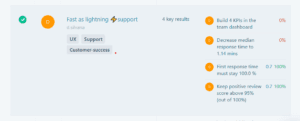
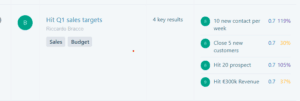
Two screenshots of the OKR written in early 2021 with the percentage of late quarter update of GTMHUB, the software adopted for their management.
The approach has also travelled beyond the company. WWG teams wrote OKRs inside the Open Innovation project with IULM and Colmar, and WWG worked with teachers at the Istituto Niccolò Machiavelli in Pioltello on a project that taught third-year students to use OKRs. You can read about it on the WWG School page. If your teams work in sprints, the OKR check sits comfortably beside sprint planning and, in larger set-ups, beside PI Planning.
What does a quarterly OKR template look like?
A quarterly OKR template has one Objective, three Key Results, an owner and a score. Copy the structure below into any tool, or a shared document, and fill it in with your team. Keep the wording short enough to remember without opening the file.
- Quarter and team: for example Q1, the platform team.
- Objective: one sentence, qualitative, inspiring.
- Key Result 1, 2 and 3: a number, a start value, a target value and an owner each.
- Score at quarter end: 0 to 1.0 per Key Result, with one line on why.
- What we learned: one line on what to keep, change or drop next quarter.
If you want help turning this into a working routine for a software team, our software development process implementation service covers it.
To talk through how OKRs could work in your team, write to us at business@wwg.it.
Sources
- Wikipedia, Objectives and key results — https://en.wikipedia.org/wiki/Objectives_and_key_results
- Google re:Work, Set goals with OKRs — https://rework.withgoogle.com/intl/en/guides/set-goals-with-okrs
- WhatMatters.com, What is an OKR? OKR meaning, definition and examples — https://www.whatmatters.com/faqs/okr-meaning-definition-example
- Atlassian, OKRs: a guide to objectives and key results — https://www.atlassian.com/agile/agile-at-scale/okr
- Andrew S. Grove, High Output Management, 1983
- Marco Imperato, Product Heroes, OKR: practical examples and tips for better organisation (page did not respond to automated checks; verify by hand)
FAQ
Frequently Asked Questions
A team should have a small number of OKRs, because focus is the whole point. Google's guidance is three to five objectives with about three key results for each, and many teams start with fewer. If everything is a priority, nothing is, so cut any objective that would not change how the team spends its quarter.
A score of about 0.7 on a scale from 0 to 1.0 is a good result for ambitious OKRs. Google describes the sweet spot as 60–70% and says that consistently reaching every objective means the goals are not ambitious enough. A team that scores 1.0 every quarter should aim higher next time.
OKRs are generally credited to Andrew Grove, who introduced the approach at Intel in the 1970s and documented it in his 1983 book High Output Management. John Doerr attended a course taught by Grove at Intel and later introduced OKRs to Google's leadership in the early 2000s, from where they spread to many other companies.
Yes, OKRs work at any size, because they depend on clarity rather than headcount. A three-person team can write one Objective with three Key Results in a short meeting and score it at the end of the quarter. OKRs have also been used for non-profit projects and in school classrooms, where the same structure keeps everyone pointing at one target.